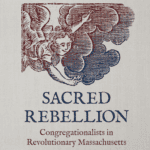
In conjunction with our Religion of Revolution: Congregational Voices on Liberty digital exhibition, the CLA was pleased to launch our second annual Adopt-a-Book program in 2025. Adoptions supported the library’s core activities: to conserve, acquire, digitize, and archive materials that help us preserve and interpret the Congregational story.
Twenty-one staff-recommended selections were up for adoption, chosen for their connection to the American Revolution or other revolutionary moments in Congregational and American history. You could adopt the sermon John Adams called his “chatechism” of political liberty, Jonathan Mayhew’s A Discourse Concerning Unlimited Submission and Non-Resistance to the Higher Powers (1750), or a pious reflection written towards the end of the war, Phillip Payson’s A Memorial of Lexington Battle, and Some Signal Interpositions of Providence in the American Revolution (1782). More recent materials include Favorite Recipes from Meeting House Lane, a cookbook published in 1975 by the Women’s League of the First Congregational Church, Madison, CT to celebrate the bicentennial of the American Revolution. You can also support our acquisition of materials on revolutionary figures from other times, such as a manuscript volume of J.T. Tucker’s sermons preached during the Civil War and Herman Edward Thomas’ 1995 biography, James W.C. Pennington: African American Churchman and Abolitionist.
Scroll down to view the materials that were up for adoption. Although our 2025 campaign has ended, a few materials are still available to adopt.
If you would like to support the CLA by adopting one of these items, contact Director of Development Heather Kurtz at hkurtz@14beacon.org or 617-523-0470 x230.
Books That Were Available for Adoption
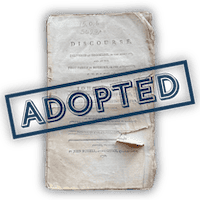
A Discourse . . . Recommended by John Adams, President of the United States, for Solemn Humiliation, Fasting & Prayer (Boston, 1798)
Eliphalet Porter
ADOPTED
A sermon given in response to a brewing quasi-naval war with France. Porter encouraged his listeners to “[lay] aside . . . all personal animosity and contention . . . with respect to the purity of the motives, by which we are respectively governed” for the sake of national unity and peace in the face of foreign dangers.
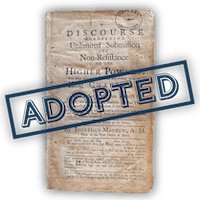
A Discourse Concerning Unlimited Submission and Non-Resistance to the Higher Powers (Boston, 1750)
Jonathan Mayhew
ADOPTED
A collection of sermons bound together, likely by a later collector. First in the volume, and perhaps most famous among Mayhew’s sermons, is his Discourse Concerning Unlimited Submission, which was delivered on the 100th anniversary of the execution of Charles I. Selected for reprint in John Wingate Thornton’s 1860 The Pulpit of the American Revolution, the sermon clearly influenced how New England Congregationalists thought about the American Revolution.
Part of Religion of Revolution: Congregational Voices on Liberty
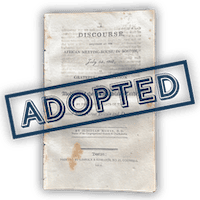
A Discourse, Delivered at the African Meeting-House . . . In Grateful Celebration of the Abolition of the African Slave-Trade (Boston, 1808)
Jedidiah Morse
ADOPTED
An address “written, preached, and published at the request of the Africans and their descendants in Boston, amounting to about twelve hundred souls, among whom originated the proposal of keeping a day of Thanksgiving in commemoration of the Abolition of the Slave Trade.” The sermon castigates the evils of slavery but also praises the “benefit” of slavery for Christianizing many people from Africa. The CLA’s copy was owned by a woman, Elizabeth Champney.
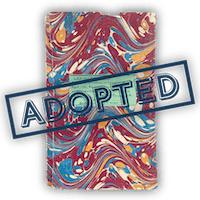
A Memorial of Lexington Battle, and Some Signal Interpositions of Providence in the American Revolution (Boston, 1782)
Phillips Payson
ADOPTED
A sermon preached at Lexington, MA on the seventh anniversary of the battle that had begun the Revolutionary War. He took for his text Exodus 12:14, “And this Day shall be unto you for a Memorial.” Payson’s sermon looked both to the past and to the future with assured confidence that God was on the side of New England and the new nation.
Part of Religion of Revolution: Congregational Voices on Liberty
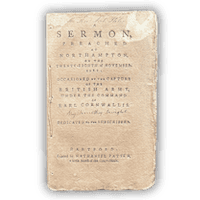
A Sermon . . . Occasioned by the Capture of the British Army, Under the Command of Earl Cornwallis (Hartford, CT, 1781)
Timothy Dwight
Available to Adopt for $2,000
A sermon to commemorate the American and French victory at Yorktown, Virginia against the British. Dwight (a Congregational minister who served as a chaplain during the Revolutionary War and later became president of Yale) wrote that while he praised God for the victory, he hoped that his audience would treat the day as a solemn occasion and abstain from “levity and sin.” He gave this copy to another Yale President, Ezra Stiles, whose name is on the front cover.
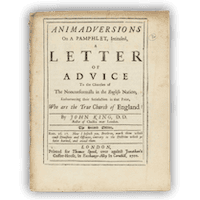
Animadversions on a Pamphlet, Intituled, A Letter of Advice (London, 1702)
John King
Available to Adopt for $250
A pamphlet by English clergyman John King, the rector of Chelsea in London. It heavily criticized a pamphlet by Cotton Mather titled, A letter of advice to the churches of the non-conformists in the English nation. In his pamphlet, Mather had critiqued the Church of England, feeling that the nonconformists, predecessors of New England’s puritans, represented the “true” church.
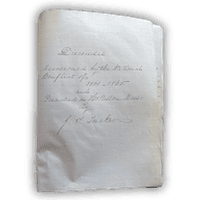
Discourses Occasioned by the National Conflict of 1861-1865 (Holliston, MA, 1861-1865)
J.T. Tucker
Available to Adopt for $1,000
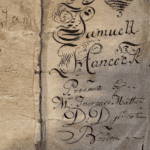
Twenty-five manuscript sermons preached during the American Civil War by Rev. J.T. Tucker who served the church in Holliston, MA from 1849 through 1867. Tucker noted that some of the sermons “were prepared in much haste, as called for by the changes of that conflict.” Of particular interest is a sermon from 1861 on the inauguration of Abraham Lincoln and another on his death in 1865.
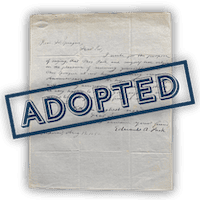
Edwards Amasa Park Letters (Andover, MA, 1850s)
Edwards Amasa Park
ADOPTED
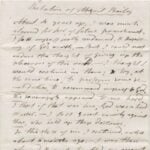
A collection of rare letters that document Rev. Edwards Amasa Park’s effort to gather information about the famous abolitionist and theologian Rev. Samuel Hopkins (1721-1803), whose biography he was writing. Today, the men remain connected at the Congregational Library & Archives: the bust of Park stares across the reading room at the painting of Hopkins.
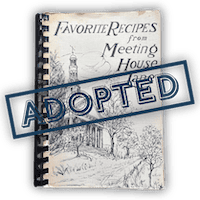
Favorite Recipes from Meeting House Lane (Madison, CT, 1975)
Women’s League of First Congregational Church
ADOPTED
A cookbook published in anticipation of the nation’s bicentennial. This charming book features handwritten recipes accompanied by hand-drawn illustrations and a rhyming couplet on each chapter page. Publishing a cookbook in celebration of the bicentennial was a popular fundraising tool for many Congregational churches between 1974 and 1977.
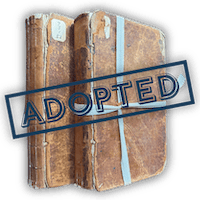
History of the Rise, Progress, and Termination of the American Revolution (Boston, 1805)
Mercy Otis Warren
ADOPTED
One of the first histories of the Revolution, and the first by a woman. Mercy Otis Warren rose to prominence during the American Revolution as a committed patriot. She wrote poetry, plays, and histories on political themes and corresponded with many of the movement’s leading figures, including John Adams, Abigail Adams, Thomas Jefferson, and George Washington.
Part of Religion of Revolution: Congregational Voices on Liberty
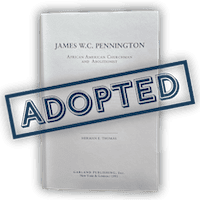
James W.C. Pennington: African American Churchman and Abolitionist (New York, 1995)
Herman Edward Thomas
ADOPTED
A biography of abolitionist and minister James W.C. Pennington. Born into slavery where he was not taught to read or write, Pennington escaped and would later become the first Black student accepted to Yale Divinity School. He was ordained in the Congregational church, organized the first Black missionary society to support the return of the Amistad captives, and wrote what is believed to be the first history of African Americans.
Notes on the History of Doctrine (New Haven, CT, 1876-1877)
Thomas Rutherford Bacon
ADOPTED
A notebook in which Thomas Rutherford Bacon wrote out all he learned in his Yale Divinity School classes about Congregational doctrine. Although Bacon came from a distinguished family of Congregational ministers in New Haven, he crossed the country after his time at Yale to teach Modern European History at the University of California for the rest of his life.
Proceedings of the General Convention of Congregational Ministers and Delegates in the United States (New York, 1852)
Joel Hawes
ADOPTED
A book documenting the first national gathering of Congregationalists since the Cambridge Synod in 1648. This item offers a snapshot of a critical moment in the history of Congregationalism, when over 400 pastors traveled to Albany to discuss and chart the church’s future. The proceedings are followed by Rev. Joel Hawes’ sermon, “Christ and Him Crucified.”
Records of the Salem Witch-Hunt (Cambridge, 2009)
Bernard Rosenthal
ADOPTED
The authoritative collection of primary source documents from the Salem witch trials. A team of editors transcribed every extant document connected to the trials, including several of the records that are included in the Congregational Library & Archives’ New England’s Hidden Histories digital archive.
Senate No. 17. Memorial. Committee on the Marshpee Indians (Boston, 1834)
Phineas Fish
ADOPTED
The statement of Phineas Fish, Congregational minister to the Mashpee Plantation, to the Massachusetts Senate and House of Representatives, in response to a petition from the Mashpee Indians. Chafing under state-imposed guardianship laws and encouraged by Methodist Pequot itinerant preacher William Apess, the Mashpee had turned to the courts to eject Fish from his position preaching in their meetinghouse and to regain their land which he unlawfully assumed title over.
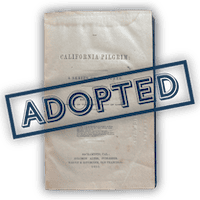
The California Pilgrim (Sacramento, CA, 1853)
J.A. Benton
ADOPTED
A collection of lectures reflecting on life in Sacramento during the Gold Rush and immediately following the Great Conflagration of 1852. Incorporating illustrations to help his East Caost readers visualize his storytelling, Rev. Joseph Benton provided unique insight into the Gold Rush and its accompanying social ills (e.g., gambling, drinking, smuggling, etc.) and attempted to enforce a moral structure.
The Improved Class-Book for Sunday-School Teachers’ Minutes (New York, early 20th century)
First Congregational Church, Norwalk, CT
ADOPTED
A record book used by Miss Kate L. Bartram of the First Congregational Church of Norwalk, Connecticut. This document, published by the American Sunday School Union in Philadelphia, records the attendance of Miss Bartram’s class of young girls.
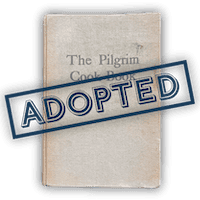
The Pilgrim Cook Book (Champaign, IL, 1926)
West Side Circle of the Ladies Society of the Congregational Church
ADOPTED
A delightful collection of regional recipes reflective of both its region and time period. The inclusion of regional advertisers provides a glimpse into both the role of women and the services considered desirable for their domestic success. Although a cookbook, the authors used subtitles throughout to remind readers that “Cooking Good Things To Eat Is A Profession.”
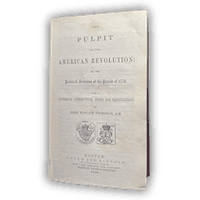
The Pulpit of the American Revolution (Boston, 1860)
John Wingate Thornton
Available to Adopt for $500
A nineteenth-century analysis of nine Revolutionary-era sermons that explicitly tied the American Revolution to Congregational principles. The author, John Wingate Thornton, was one of the original donors of materials to the Congregational Library & Archives in 1853.
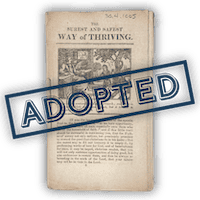
The Surest and Safest Way of Thriving (19th century)
American Tract Society
ADOPTED
A nineteenth-century tract produced and distributed by the American Tract Society. This short document argued for the importance of performing charitable acts because “the surest way to fill our treasury is to empty it, by performing works of love for God, and of benevolence for men.” The first page features a lovely illustration, which is likely a wood engraving.