
Why I Adopted a Piece of Hancock History (And Why You Should Adopt a Book, Too)
- Jeffrey Griffith
- March 26, 2026
Dr. Jeffrey Griffith
2026 marks the 250th anniversary of the most iconic moment in John Hancock’s political career. While the signing of the Declaration of Independence has emblazoned the President of the Continental Congress in the annals of history, that singular action belies his contributions as an economic leader and social figure. Additionally, the first governor of the Commonwealth of Massachusetts had extensive roots in the religious bedrock of the region.
Most notably, Hancock’s father served as a Congregational minister in Braintree, while his grandfather served a congregation in Lexington for over five decades. Conceivably, if Hancock did not lose his father when he was only seven years old, he would have followed in the previous two generations’ footsteps.
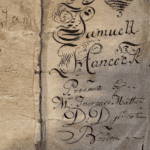
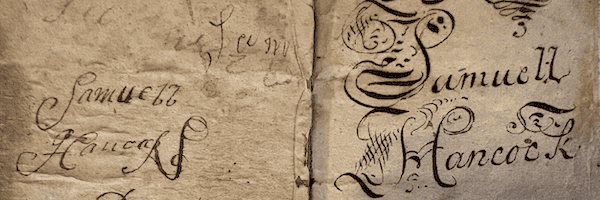
The wider Hancock family also contributed to religious activity in Massachusetts. Recently, the Congregational Library & Archives acquired a fascinating pamphlet from 1716, Two Discourses Shewing, I. That the Lords Ears are Open to the Prayers of the Righteous… by Increase Mather. On the first page in elegant script from 1722, Samuel Hancock notes that the pamphlet was “presents by” Mr. Increase Mather.” According to American Ancestors, though Samuel Hancock (1672/3 – 1735) did not serve as a minister like his brother John did in Lexington, he was baptized as an adult and was admitted as a member to the Lexington Congregational church. Approximately a year later, Samuel Hancock returned to Cambridge, and at some point, he served as a Deacon.
This pamphlet stands as a significant addition to the Congregational Library & Archives’ collection. For scholars of religion, the ability to study Increase Mather’s messages offers insight into a critical figure’s understanding of Christianity in New England society. For those interested in Hancock, like myself, considering how the family interacted with notable individuals and utilized their own standing in the community illustrates how their descendent, John Hancock, used his roots to legitimize his own aspirations.
Over the past few years, the Congregational Library & Archives has provided the opportunity for supporters to “adopt” items in their collection. Funds raised through the Adopt-a-Book program support the continued work of staff at 14 Beacon to conserve, preserve, and make the item readily available to researchers for both in-person and digital research. The Adopt-a-Book program includes printed materials that span centuries, providing supporters the ability to select subjects that are of particular interest to them.
I personally consider it a distinct honor to have my name on the catalogue entry for this Increase Mather pamphlet, once owned by John Hancock’s great-uncle. For my own work, learning about this pamphlet has led me to consider the depths of the Hancock family’s religious influence in the region, and has required me to consider the “family” beyond his “traditional” linear paternal ancestry.
The Congregational Library & Archives’ Adopt-a-Book program reflects the rich breadth of their collections. While the recognition of individual support can be appealing, the true reward of supporting this program is knowing you have advanced historical scholarship and study. By making items readily accessible, more scholars can bring their unique and unexpected questions to the source material, resulting in insights that may shape how we view and understand the past.
To find out more about the CLA’s Adopt-a-Book program, peruse the selections, and review pricing, please visit congregationallibrary.org/adopt-a-book