
Boston Tea Party at 250: Congregationalists and the American Revolution
How important was Congregationalism to Boston’s infamous 1773 Tea Party? (Spoiler: Very Important)
On December 16, 1773, Bostonians marched out of Old South Meeting House and destroyed three cargoes of East India Tea. This was one of the greatest acts of civil disobedience of all time, and the event that precipitated the Revolution. Why did this happen? What was the political background to the Destruction of the Tea (it would not be called the Tea Party for another half-century)? And why was Massachusetts already on the road to rebellion when the Tea Party took place?
In this virtual discussion, Dr. Robert Allison and New England’s Hidden Histories Project Director Dr. Tricia Peone explored special documents in the CLA collections related to the Boston Tea Party and discussed Congregationalism’s connections to this momentous event.
This program was part of Revolutionary Stories, New England’s Hidden Histories’ ongoing series on the American Revolution and the Congregational experience.
LINKS TO RESOURCES MENTIONED IN THIS VIDEO:
- Old South Church Records in the NEHH Digital Archive
- Phillis Wheatley Peters’ Admission Record to Old South Church in the NEHH Digital Archive
- The Massachusetts Convention of Congregational Ministers’ Record Book Featuring Rev. Jonathan Mayhew in the NEHH Digital Archive
- New England’s Hidden Histories
- Religion of Revolution Digital Exhibition
Do you have a question about materials in our collection at 14 Beacon? Get in touch anytime at ref@14beacon.org.
DECEMBER 6, 2023
TRICIA PEONE: Good afternoon. Thank you for joining us today. My name is Tricia Peone, and I’m the Project Director for New England’s Hidden Histories at the Congregational Library & Archives.
Welcome to today’s virtual discussion on “The Boston Tea Party at 250: Congregationalists and the American Revolution” with Dr. Robert Allison.
To begin, I want to acknowledge that the Congregational Library & Archives resides in what is now known as Boston, which is in the place of the Blue Hills, the homeland of the Massachusett people, whose relationships and connections with the land continue this day and into the future.
For those joining us for the first time, the Congregational Library & Archives is an independent research library. Established in 1853, CLA’s mission is to foster a deeper understanding of the spiritual, intellectual, cultural, and civic dimensions of the Congregational story and its ongoing relevance in the 21st century.
We do this through free access to our research library of 225,000 books, pamphlets, periodicals, and manuscripts, and our digital archive with more than 100,000 images, mostly drawn from our New England’s Hidden Histories project.
Throughout the year, we offer educational programs and research fellowships for students, scholars, churches, and anyone interested in Congregationalism’s influence on the American story.
Please check our website, congregationallibrary.org to learn more about what we do and for news of forthcoming events.
Before we begin, I’d like to tell you briefly about the New England’s Hidden Histories project here at the CLA. New England’s Hidden Histories digitizes and provides access to early New England Congregational church records. The project comprises an online collection of manuscript records from approximately 1620 to 1850, which includes letters, sermons, diaries, church record books, relations of faith, disciplinary cases, account books, as well as lists of members, baptisms, marriages, and deaths.
These valuable but often overlooked documents provide firsthand accounts of a broad range of community events, including personal accounts and sermons from the American Revolution. You can explore the digital archive on our website.
So I have the pleasure this afternoon of introducing our speaker, Dr. Robert Allison, who chairs Revolution 250, and serves as president of the Colonial Society of Massachusetts, and is a professor of history right next door to us at Suffolk University. And his books include Short Histories of the American Revolution and The Boston Tea Party. Welcome, Dr. Allison.
ROBERT ALLISON: Welcome, everyone. Thank you all for joining us this afternoon for this discussion of Congregationalists and the American Revolution.
You know, when we talk about how did the Revolution begin? When did it begin? There are a number of dates that we could throw out.
For our purposes this afternoon. I’ll mention 1751 and this gentleman, Rev. Jonathan Mayhew. In December of 1750, January of 1751, he hears an alarming rumor that the Anglican clergy in Boston are going to be… do some, do something he finds really distasteful in January.
You know, the Congregationalists had somewhat broken with the Anglican communion back in the 17th century. That’s really a subject for another day. And one of the things the Congregationalists did not do that the Anglicans did was they did not observe saints days. Saints aren’t scriptural. This was a, something added afterword. However, the Anglicans, as did the Roman Catholics, observed saints days. And there’s a process for attaining sainthood.
And in January of 1751, the Anglican clergy in Boston were going to observe a saints day for Charles I who was a saint in the Anglican church. He was, however, the reason many of these Congregationalists had come to New England.
Charles I, according to the Congregationalists, A: even if they believed in saints, would not qualify as one. So to prevent the Anglicans from breaching what Rev. Mayhew thought would be a tremendous wall of decorum, he, in January of 1751, issued a series of sermons explaining why Charles I could not be a saint. He could not be a saint because he was a bad man and a bad king. And how do we know someone is a bad king? Who sits in judgment on the king?
It’s not simply Rev. Mayhew trashing King Charles I, who is, of course, the reason that brought the puritans to the New World. Blasting the whole idea of kingship, of sainthood, but more importantly, raising the issue of who sits in judgment on those in power.
And for Rev. Mayhew, the answer is clear in this series of sermons. Those who are governed sit in judgment on their governors. They are the ones who determine whether someone is a good ruler or a bad ruler.
It’s not through divine right that Charles I held the throne. He held the throne through the sufferance of his people. And when they had had enough of him, they did the right thing by ousting him.
So, Rev. Mayhew explains who submits to power. The people don’t submit to the power of their governors. The governors submit to the power of their people.
So this is a powerful sermon. As you can see, Rev. Mayhew goes to the trouble of having it printed, and it circulates throughout New England over the next generation. It becomes really the text for how we understand the relationship of those governed to those in power and who judges whom.
And Mayhew, who was the pastor at Old West Church or Old West Meetinghouse, which I’ll talk about in a bit, was really one of the most extreme in advancing what was pretty much a common doctrine among the Congregationalists about power.
He goes a bit further in 1765 during the whole Stamp Act crisis, when Rev. Mayhew in August of 1765 gives another fiery sermon about power and about the abuse of power.
Next, few days later, thinking that Rev. Mayhew was attacking Gov. Thomas Hutchinson, and Hutchinson is also a Congregationalist. He worships at another church.
A mob attacks Gov. Hutchinson’s house in the North End and burns it. Now Mayhew steps back a bit after this, not wanting to cause this kind of violence, but you can kind of see how the rhetoric of the clergy, or the sermons of the clergy are inflaming the public mind.
One member of the Old West Meetinghouse is Richard Clarke, and Mr. Clarke is the largest, one of the largest tea merchants in New England, and he’s a member of the Old West Church. He’s also related by marriage to Gov. Hutchinson.
He leaves the Old West Church as a result of this attack on… the attack on Hutchinson’s house. He doesn’t believe that Mayhew has really distanced himself from the violence. So he leaves the church, and he goes to another. The one he goes to is the Brattle Street Church. And that’s presided over by Samuel Cooper. And we’ll be talking more about the Rev. Cooper in a bit, because Cooper, like Mayhew, believes that people sit in judgment on their governors.
Unlike Mayhew, Cooper writes extensively under assumed pseudonyms for the Boston press. He is really one of the behind the scenes people advancing the ideas, not only of Mayhew, but of Samuel Adams and others.
But unlike Mayhew, Cooper is very good at appealing to a broad swath of the community. So Mr. Clarke is going to remain a member of the Brattle Street Church, actually, until he leaves as a result of the destruction of the tea in 1774.
And so you have the clergy taking a very active role in politics. Sometimes like Mayhew, advancing these ideas. In other cases, like Cooper operating a little more subtly and in some ways more effectively.
Rev. Mayhew passed away in 1766, so he’s no longer part of the story. But Cooper very much will be part of the story.
And we’ll just talk a little bit now about how we have so many churches in Boston in the 1760s. It’s a town of about 12,000 people, and the churches are overwhelmingly Congregationalist. There are three Anglican churches, one Baptist church, and the other 14 or 15 are all Congregational.
And we have the First Church in Boston. Again, the Congregationalists not believing in saints… I’m a little embarrassed now to be explaining to you how the Congregationalists named their churches. And next, I’ll probably be explaining Congregational theology to you and do other things that will embarrass me.
But the churches are numbered, or given a directional, or a description so people know where they are. They’re not named for saints. These are things I need to explain to my audiences who are not so well versed in the theology.
So the First Church, of course, and the church, as you know, is not the building, it’s the congregation. And this was the First Church, those who came in 1630.
And then as the community grew, there needed to be a Second Church. And the Second Church was in the North End of Boston, and it was called either the Second Church, or the North Church, or the North Meetinghouse. And this was the meetinghouse of the Mathers in the 17th and early 18th century. And in fact, Samuel Mather, the grandson of Increase, the son of Cotton, had been the pastor there into the mid 1700s.
And then the Third Meetinghouse or Third Church is what we would call, we now call Old South. But it was not called the Old South because it was the only one in the South End of town. So it was the South Meetinghouse.
And then as the area grew, there needed to be another south meetinghouse. But also there was a dispute within the South Meetinghouse that led to the formation of a New South Meetinghouse. And it’s at this point in the, early part of the mid, you know, the first third or so of the 1700s, that the, what we call the Old South Meetinghouse became the Old South Meetinghouse, because now there was a New South Meetinghouse. The old…
And then in the 1680s, as you’re probably aware, the royal government, the… King James II and King Charles II wanted to have an Anglican church, a Church of England in Boston. And this is what brought us King’s Chapel, the first Anglican meetinghouse in Boston, something that came with great controversy.
At first there was an idea that we can simply share the pulpit. So the Anglicans will have their worship services at nine in the morning. And then at ten, the Congregationalists can go in. And the Congregationalists thought that the Anglicans were malingering, holding them up. So they had to wait out in the street, which, to go into their own meetinghouse, which they thought was unfair.
So a new meetinghouse, King’s Chapel, was built. And the current edifice was built in the 1740s. And then there is a dispute at the North Meetinghouse, within the congregation, an argument among members of the congregation and the clergy, which leads to the breaking off and creating a New North Meetinghouse.
And at this point, the Second Meetinghouse, the church of the Mathers becomes the Old North Meetinghouse.
This is a subject of further confusion because there is, of course, in the North End, the Old North Church. But that’s not to be confused with the Old North Meetinghouse and the new one, since it was made of brick was also sometimes called the Brick Meetinghouse. Or sometimes it would be called by the name of the pastor. And for much of the period I’ll be talking about, the pastor was Andrew Eliot. So sometimes it was Mr. Eliot’s meetinghouse.
And so in this dispute, those who left believed that those who remained in the North Meetinghouse or Old North Meetinghouse were betraying the faith. And so they put on top of the steeple this elegant woodcock, a weathervane in the shape of a cock, a bird that crows, a rooster. You all know what a rooster is.
The symbolism there was very rich, of course, for all of us, because this refers to Peter the Apostle denying Jesus. And in fact, when they mounted the cock onto the steeple, this is in 1719, as a way of bringing this point home, a member of the congregation climbed up onto the steeple and sat on this weathervane and crowed three times so everyone would get the point of why this new church has this weathervane on top of it shaped like a cock.
By the way, it wound up over in Cambridge at the First Church in Cambridge. And a few years ago they took it down because, as you can see, having been in the elements now for more than 300 years, it’s showing a great deal of wear.
So one of the main reasons for establishing these new places of worship, in addition to a growing population, is because those within them can’t get along, or they disagree.
And remember a fundamental argument of Mr., Rev. Mayhew’s was you have a right to sit in judgment on those who are governing you.
And then with a growing Anglican population in the early 1700s, we have yet another Anglican church, the Old North or the Christ Church in the North End. And then, the actually, this was a church started by Scottish Presbyterians back in the 1720s or so on Long Lane, hence it was called the Long Lane Meetinghouse. And in the 1780s it becomes a Congregational church also called the Long Lane Meetinghouse.
Later, when Long Lane is changed to Federal Street, it becomes the Federal Street Meetinghouse. And now it is the Arlington Street Meetinghouse because it moved to Arlington Street.
You know, it makes a great deal of sense to name the meetinghouses for the place where they are so we can find out where to go when we are on our way to church.
And then a number of new churches started in the middle years of the 1700s, some in relation to population shifting and some because members of the existing congregations really couldn’t get along. So there’s another Anglican church, Trinity Church, another Congregational church in the South End on the neck, the Hollis Street Church, and also the Old West Church, the church of the Rev. Mayhew that started, I think, in the 1740s.
And this shows us Boston. This is Paul Revere’s great engraving of the arrival of the British troops. And what Revere was doing in this, it’s a wonderful piece of propaganda showing the number of church steeples in town. The British troops are coming because Boston is such a riotous place. But what Revere is showing is it’s not really a riotous place. People are busy going about their worshiping and not rioting in the streets. You don’t need British troops to keep order here.
In here, we have a close up showing some of the church steeples, this engraving that we just saw. It’s a very helpful one that actually someone in the early 19th century told us what all of the different steeples are.
And the, you can see the North End and the… actually, you can… if we could, we could do a close up, you could see the weathervane on top of that meetinghouse in the North End, which was actually where Paul Revere worshiped.
And then others going through to the South End. The church steeples are the prominent part of the Boston skyline in the way that Bostonians like to think of themselves as a very devout people.
I’ll just mention two of the ministers in Boston. There was, as I said, a Baptist meetinghouse, and Samuel Stillman was the clergyman there from the 1760s into the first decade of the 19th century. And then the Hollis Street Church, down in the South End of Boston, the pastor there was Mather Byles, who was a nephew of Cotton Mather.
And then Mather Byles converts to Anglicanism. The way the Anglicans were actually converted, getting clergy, was to convert Congregational ministers, many of whom went to Yale. So the real, the Anglican clergy were predominantly New Englanders like Mather Byles, who convert back to Anglicanism, their ancestors having left when they came to New England a century earlier.
Now the leading clergyman in New England at the time was Charles Chauncey, and he was the pastor at the First Church. And Chauncey, he will remain in Boston and will be one of… Well, his real focus was not politics but religion. And for Chauncey, one of the…A: He opposed the revival of the 1730s, 1740s.
The evangelical movement, most associated with George Whitefield, which is why Whitefield didn’t preach in the First Church. He instead went to the Brattle Street Church and other places.
And Whitfield, I’m sorry, Chauncey also was very much concerned with the Anglicans’ proposal to send a bishop to America. And he spent about ten years writing pamphlets and giving sermons, attacking the idea of having bishops sent to America.
Now, and sometimes in our more secular age, when we’re talking about causes of the Revolution, we ignore this very real one. The fear that there was going to, were going to be bishops sent to America. And bishops had not only ecclesiastical authority, but also authority, civil authority. And that was a real fear.
And Chauncey makes this argument very clear in his pamphlets. He’s a very profound writer, and his writing is very influential. Apparently, he wasn’t as gifted a speaker, and perhaps one reason he didn’t like the evangelicals is Whitefield and others were very good speakers, but Chauncey was not.
There’s a story about Chauncey doing one of his prayers, and one of the prayers he offered was that he might not be an orator, thinking that an orator was somehow diminishing his capacity to have a real spiritual relationship with God and with the congregation. And one of his friends said that Rev. Chauncey’s prayer not to be an orator was a prayer that was very certainly answered by the Almighty.
He wasn’t. So he opposes the revival. He also opposes the bishops coming, any bishops coming to America.
And so, Whitefield, and I believe there is a portrait of Whitefield in the reading room of the Congregational Library, does evangelize throughout the American colonies.
Now, there was an historical argument advanced at some point that the revival really is a precursor to the Revolution. And it’s somewhat difficult to make that argument that there is some theological connection between what Whitefield was preaching or other of the evangelicals were preaching and the Revolution.
But what we can see is that Whitefield’s travels throughout the American colonies did create networks of communication among people and broke down some barriers. So there is that importance to it.
But I don’t know you can draw a clear line between the New Lights and the Revolution, or the Old Lights and the opponents of the Revolution. And so because Whitefield is not permitted to preach in the First Church, he is… the pulpit of the Brattle Street Church is open to him.
I should also point out that among these clergy, and there are a lot of clergy in Boston, there is a real tendency to share pulpits, to have a minister from one church, one meetinghouse, go to another for sermons. And people also would shop around.
You know, Mayhew’s idea that you sit in judgment also means if you don’t like the minister in one place, you go to another. So as Mr. Clarke shows, he left Mayhew’s church and goes to Reverend Cooper’s church.
And Samuel Cooper… and his church was actually, probably the wealthiest in Boston, the Brattle Street Meetinghouse. And again, the churches have a certain, not necessarily demographic because there’s very little demographic difference among the people in Boston, but there is a certain class difference. I hesitate to use the word class here.
In 1760, there was a devastating fire in Boston, and the churches raised money for the sufferers, as churches always did. And remember, there are 17 churches in Boston at the time, and a quarter of all the money that was raised came from the Brattle Street Church. And this was twice the amount any other church raised. And it’s not because they were better people. It’s simply because they tended to be a bit wealthier.
Something like a third of the people John Singleton Copley painted were congregants of the Brattle Street Church, and Richard Clarke felt at home at the Brattle Street Church because there were also people of means there.
There’s another interesting fact that there are something like 80 Bostonians who were taxed for the tonnage of their shipping. This was a… one source of revenue for the British government. 20 of them were congregants of the Brattle Street Church. So one out of every four people who had shipping that was taxed because of their tonnage were Brattle congregants. And these 20 people paid something like 49% of the total.
The churches were of different sizes too. We don’t have an exact figures about how many people belonged to each one at any given time.
But we know, actually, Andrew Eliot, who was the pastor at one of the North End churches, did make kind of a list in 1761. There were about 300 families in his church, the New North. And we don’t think he’s exaggerating. He was a very popular minister, and the New North Church actually did have more middle class, poorer people in it, attracted by the Reverend Eliot’s preaching.
Brattle Street had 280 families. So this is the next largest. And though I emphasize the wealth of the Brattle congregation, I should also point out there were some people of very modest means and even poor people in the Brattle Street Church.
One of them was Jane Mecom, Benjamin Franklin’s sister, who always was on the verge of failure. The Franklins, as you probably know, were hard working people, but quite destitute, except of course, for Benjamin Franklin, who’s a different story. And Benjamin Franklin, by the way, and Samuel Cooper, are correspondents throughout the last 20 years of their lives.
So Brattle Street is about 280.
Trinity, the Anglican church, has about 250 families.
And then Old South, which we’ll be talking a little bit about, had about 200 families.
Then the First Church and the West Church, each has about 150 families as members of the church.
But again, families could move around or shift around. And the ministers, too, would circulate among the different churches.
So Samuel Cooper of Brattle Street was known either as Silver-Tongued Sam. He was a very good speaker. And also the Divine Politician. As I said, he was very much involved in the patriot movement, but his church was a place where someone like
Richard Clarke would feel welcome and would feel at home. He kept politics out of his sermons, unlike the Rev. Mayhew. However, he’s also writing things for the press under different names. And he is close, not only to someone like Benjamin Franklin, but to members of his congregation like John Hancock, or Joseph Warren, or John Adams, who definitely are part of the patriot movement.
Now, Gov. Hutchinson, who goes to one of the North End churches, in 1770 in the wake of the Boston Massacre, Gov. Hutchinson thinks it will be much safer for the government of Massachusetts to not be in Boston. Because Boston, the thinking is, you’re susceptible to mobs and pressure from the Sons of Liberty and these other groups. And remember, the Sons of Liberty had torn down Mr. Hutchinson’s house back in 1765. So it’s not as though he has… it’s an irrational fear on his part of the pressure the mobs can bring to bear.
So he wants to move the government to Cambridge and to Harvard College, actually, to… Because there you have nice commodious buildings, Harvard Hall and Massachusetts Hall, which still stand. And during a Yellow Fever outbreak back in the earlier 1760s, the General Court had, in fact, met at Harvard Hall. And so it’s not something without precedent.
However, two members of the Harvard Corporation, Rev. Chauncey and Rev. Cooper opposed this. Not on theological… They’re not doing this as ministers. They are doing this as members of the Harvard Corporation, fearing that this will somehow compromise Harvard’s independence by having the government meet there.
It really baffles Gov. Hutchinson. He refers to this as the revolt part of the revolt in 1770, when he can’t get a simple approval to have the government of Massachusetts meet in Cambridge. And at the meeting when Rev. Cooper says he’s doing this for a concern for Harvard and not out of any party spirit or spirit of faction, Hutchinson says no one believed him.
Hutchinson thinks, of course, that Cooper is part of the opposition, which certainly he is, even though Cooper is trying to make it clear he is not.
See something as simple as where the government meets is going to meet with trouble when it happens to run afoul of the interests of Bostonians like Samuel Adams, Joseph Warren, who very much want to keep the government in Boston precisely because it will be influenced by the people of Boston.
Then in 17…
And actually, you can also see this in another piece of this, William Billings. And this is from his “New England Psalm Singer,” is one of the, actually the first American composer, unless you’re from Philadelphia, in which case you’ll want me to talk about Francis Hopkinson.
But Billings writes, sets psalm tunes to music. And for the Congregation… the Congregationalists, were beginning to allow music other than psalms to be used in the churches. They’re not going as far as the Anglicans. The Anglicans actually have church organs. And this is much too… it’s a step too far for the Congregationalists at this time.
However, Billings writes very sophisticated song tunes, songs that are done in multiple voices.
And in 1770, the same year as the Harvard revolt, he writes, probably his most enduring song, “Chester,” which becomes during the Revolution, essentially the national anthem. “Let tyrants shake their iron rod and slavery clank her galling chains. We fear them not. We trust in God. New England’s God forever reigns.”
Later during the Revolution, there will be verses added about Clinton, Burgoyne, and Howe.
But in 1770, we’re just talking about slavery and tyrants. Seeing this is what happens when you allow unchecked power in a way that Rev. Mayhew had warned us about. So this is what people are singing in their worship services in… among the Congregationalists in 1770, when the Congregational clergy in Massachusetts are trying to block the governor from moving the capital out of Boston.
So Hutchinson… and Hutchinson really becomes the focus of antipathy for the patriots, as well as for the clergy in 1770, 1771. You can see this beginning to happen here.
And in 1771, as governors would do, Gov. Hutchinson issues a Thanksgiving Proclamation. That is, he proclaims a Day of Thanksgiving.
Now, it had been that back in the 17th century and early 18th century, Days of Thanksgiving might be called if there was some particular thing we want, for which we wanted to give thanks. Later on, it becomes a standard thing. In the fall, you have one day of Thanksgiving.
There were also Days of Fasting that the governor would call. And in Gov. Hutchinson’s Thanksgiving Proclamation, one of the things for which he wants the people of Massachusetts to give thanks is for their civil and religious privileges.
This outrages some of his more pious, and actually some of his more antagonistic constituents who think giving thanks for these things suggests that it’s really thanks to Gov. Hutchinson and the British government that we have them, when we see these attempts by them to take them away.
And so when Hutchinson issues his proclamation, pressure is put on every clergyman in town, and some of them actually were applying the pressure themselves, not to read the governor’s proclamation.
And in fact, no one in Boston does, except for Ebenezer Pemberton, who happened to be the pastor of Hutchinson’s church, the New North Meetinghouse. And Pemberton is the only Congregational clergyman in Boston who remains a supporter of Hutchinson as well as of the royal government.
And there is some argument that it’s, that for that reason that his congregation was dwindling. There’s also an argument that he was just kind of a, an unpopular guy. He was apparently very pompous. And who am I to talk about someone else being pompous?
As I said, clergy liked to share pulpits. And when Andrew Eliot proposed to Pemberton that maybe they swap pulpits, that Pemberton go preach in Eliot’s church and that Pemberton preached… and that Eliot preached in Pemberton’s. Pemberton said no, no, no. My congregation really wouldn’t want to hear anyone else, anyone other than me. And he might have been right, but his congregants were certainly leaving his church to go hear other people. So he ultimately is left pretty much without a congregation.
He does, however, read Gov. Hutchinson’s Thanksgiving Proclamation, and the other clergy in Boston do not, not wanting to put thanking the governor for civil… thanking even God for civil and religious privileges as something on their agenda.
So, as we know, this is the 250th anniversary of the destruction of the tea in Boston, and certainly a very big occasion for us.
But actually, if we were in Boston in 1773 and were a member of the Brattle Street Church, we would know that the really big thing was the building of the new meetinghouse. And the old meetinghouse, built in 1699, had really served its purpose. And so the meetinghouse… the church wanted to expand.
And so this is a big deal, as you probably, you must know, if you’ve been involved with any kind of a church project. Building a new meetinghouse is a major project.
And here we have an interesting thing. James Bowdoin, who is one of the members of the congregation, offers a piece of land much bigger than their existing parcel, which is now in the area of the Government Center T station where the Brattle Street Meetinghouse was.
Bowdoin offers a piece of land that is up, further up Tremont Street, Tremont and Howard Street near the junction of Hanover Street. An area that no… a place that no longer exists. It’s under Center Plaza now. But a bigger piece of land, actually, on a hill overlooking this area, facing down Hanover Street, which was one of the main streets in Boston. Very generous offer on the part of Mr. Bowdoin, who is one of the wealthiest men in town.
And he also has some lumber and bricks. There’s a building on it. He says, you can take that down and use that building materials. And what he wants in exchange is for a pew in the meetinghouse. Instead of paying his annual fee, he will have it because he had donated the land.
And this very generous offer is rejected. The new meetinghouse is on the same plot as the old one, and it is smaller than what could have been accommodated on Bowdoin’s land.
And here the real opposition to it is led by another parishioner who’s also one of the wealthiest men in town, John Hancock.
Now, Hancock and Bowdoin are both patriots, leading patriots in Boston. And this is church politics that Hancock doesn’t want Bowdoin to get the credit for giving the land. And in fact, Hancock’s Aunt Lydia gives the Brattle Street Church a house for the minister to live in and the deacon to live in. And it has that house into the early 19th century.
So for me, one of the big things we see in this is contention within the church between people who are on the same side politically, one not wanting the other to get the credit for something like giving them the land.
But the church does build a new, does a build an elegant meetinghouse. One of the striking features of it into the 19th century was a cannonball that had been fired by the patriots in March of 1776, lodged in the steeple.
And so this essentially is the story of the relationship of the Congregationalists to the Revolution. And it’s a big story.
And it’s impossible to tell the story of the Revolution without thinking about the religious motivation of these congregations of New England, each of them seeing itself as a self-governing entity.
So they didn’t need a Samuel Adams. And by the way, Samuel Adams was not a member of the Brattle Street Church. And we’ll talk, we can talk more about him some other day. And it’s really not a matter of the theology, which they are getting in their churches.
Chauncey, and Cooper, and even Mayhew were theologians as well as political actors, in some cases more so. But it’s not that they heard a sermon saying we should resist British rule. They knew that they governed themselves. They knew that they controlled their congregations. This is why they are Congregationalists.
And it was the threat of the bishops that drove Chauncey and others really to resist these encroachments by the Anglican Church.
Now Mayhew’s basic premise was that people sit in judgment on their rulers as well as on their pastors. And this is, of course, a great challenge for someone like Gov. Hutchinson. But it’s also a great challenge for the members of the clergy, knowing that those we are, for whom we are the shepherds are criticizing us, critiquing us, judging us, and if they don’t like our church, they will go to another.
This is really the story of the Revolution, and it’s the idea that people govern themselves and that they sit in judgment on those who govern them.
Thank you very much. Now, I think we’ll have time for questions, and I really enjoyed having a chance to talk to you about this.
TRICIA: Thank you. That was great.
I particularly appreciate this visual and chronological illustration of each church and the growth of the Congregational churches in Boston. That’s really helpful for us here at the library.
So before we dive into questions, I think some of you might be interested in looking at the records of some of these churches. And the CLA has digitized records from several Boston congregations.
And I think most particularly today, you might be interested in the records of Boston’s Old South Church, which have been digitized as part of the New England’s Hidden Histories project with support from the National Endowment for the Humanities.
So this collection from Old South contains records related to significant figures from the American Revolution, such as Phillis Wheatley Peters, Samuel Adams, and Benjamin Franklin.
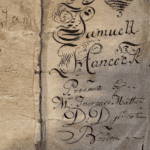
And in this image, this is an image of the admissions record book from Old South. And you can see the image on the left shows the admission of Phillis Wheatley Peters in 1771 to Old South. And on the right there, Samuel Adams.
And this, Bob, I want to ask you about this because this says… So this is in 1789, and it says he’s dismissed from Brattle Street Church and joins Old South.
Maybe you can fill us in. Maybe that can be one of our first questions is, is Sam Adams’ various congregational affiliations in this time period. So this is 1789. I think he’s lieutenant governor when he switches.
So please do explore New England’s Hidden Histories, and take a look at some of the church record books that we have digitized online.
And if I can also just show you a couple of the treasures we have in the library from the Boston Tea Party and this period.
Let me show you one. Some of you might be familiar with the story of George Hughes. He’s the subject of Alfred Young’s “The Shoemaker and the Tea Party.” And this is a first edition copy that we have in the library here on the Boston Tea Party. It’s a retrospect of the Boston Tea Party. It’s a story of George Hughes, and it’s a lovely first edition printed in New York in 1834.
And we’ve got this other really great, sort of, for antiquarian interests. This is “Tea Leaves Illustrated,” published in Boston in 1884. And this is truly a lovely binding, I think. And this is coming after the centennial celebration of the Revolution, and it’s got biographies of some of the people we were just hearing about.
So can you, Dr. Allison, can you help us with this question of Samuel Adams and his congregation first? And then I’ve got quite a few more questions.
ROBERT: That’s a very good question.
And the short answer is, I don’t know, because apparently there were two people named Samuel Adams.
We do know that Cooper becomes… Cooper is fascinating because in the 17th… His father had been the co-pastor at the Brattle Street Church, and starting in 1715, and Cooper is there until 1783. So you have a very long stretch for the Coopers.
And in the 1750s and 60s, during the war with France, Cooper is giving these wonderful sermons attacking the French. And then during the Revolution, he gives the same sermons. But this time he’s attacking the British. And he’s a great supporter of the French alliance.
And Samuel Adams is still vehement enough a Congregationalist not to want to have anything to do with a Catholic power. There’s some thinking that that is part of what makes him leave the Brattle Street Church.
But then there’s also an argument that maybe that was a different Samuel Adams, and so I don’t know.
But Samuel… by the way, a good book… There are two good books about Samuel Adams, fortunately now. Ira Stoll’s book, S-t-o-l-l, has a lot on Adams’ religious beliefs, really focuses a lot more on that than the other biographies. Stacy Schiff’s recent book is a wonderful book. It’s probably the best book to read. One of the best books to read on the coming of the Revolution. Has less to say about Adams’ religious beliefs, but I suspect… actually, when you were showing us the Hughes book, I was looking on my shelf to see if I could find one of the to answer the question quickly about what Samuel Adams was doing in 1789.
He has an interesting life, but he is a very devout Congregationalist. His father was one of the guys who starts the New South Meetinghouse, and Samuel Adams… And then, of course, Adams’ first wife was Elizabeth Checkley, whose father was a pastor at the New South.
Yeah. And Stacy Schiff is the author, S-c-h-i-f-f, a terrific book on Samuel Adams.
So thank you for asking. I mean, I could go on all day about Samuel Adams, but I know there were other questions.
TRICIA: So well, so we’ll jump into some more questions.
One is just, sort of, this is kind of a placing us generally in the arguments that historians make because from time to time historians do like to sort of reassess or reinterpret the role of religion in the American Revolution.
So could you just generally, how important was religion in the American Revolution and maybe Congregationalism in particular?
ROBERT: I think it was essential. I don’t think you can tell the story without telling this.
Jonathan Mayhew is so important, much more important than, in many ways, than James Otis, because Otis is making very sophisticated political arguments in pamphlets.
But the things people are hearing, imbibing every week in their churches… and this is the focus of people’s lives. It’s not simply something they do for an hour or once a week out of obligation. It’s the way they define themselves. And we defined ourselves as part of this community. But each of us is struggling for his or her own salvation. And so these things are really essential.
This idea of resistance to tyranny is obedience to God. And that’s what… something you get from Billings’ songs. So yeah, so it is the essential thing. And of course it becomes an issue in 1774, after the destruction of the tea, when Massachusetts gets the other states to come together in a Continental Congress.
Five members of the… of some of the… Samuel Adams, John Adams, John Hancock, Robert Treat Paine, go down to Philadelphia, and so does Isaac Bacchus, who a Baptist minister for Middleborough. And he wants to know how come his congregation is taxed to support the Congregational clergy. This is something that hadn’t occurred to the Congregationalists in the Massachusetts, in the Massachusetts Assembly.
And in fact, Robert Treat Paine says it’s not a matter of principle with you. You just don’t want to have to pay these taxes.
And Bacchus says, well, that’s exactly what the British say about you, and which is a fair point. And he says, How come you don’t pay taxes to support King’s Chapel? And Paine says, well, we don’t go to King’s Chapel. And Bacchus says, well, my congregation doesn’t go to the Congregational church.
So it’s… and the Baptists play a big role in undermine… Well, we can talk about the switch to not taxing people to support the one true faith some other time. But it is a big issue because you do have religious diversity in the rest of the country.
That’s… now I’m getting off onto one of favorite tangents, so I’ll leave it at that.
It’s a very important issue. Suffice it to say, very important issue. You can’t tell the story without it.
TRICIA: So Robert asks, did any of the ministers from the Boston churches become affiliated with militia companies or take up arms in support of the patriots?
And he mentions Rev. James Caldwell was chaplain for New Jersey Regiment and Rev. Rosbrugh from Pennsylvania, was killed at Trenton.
ROBERT: Yes.
And we know that Rev. Emerson from Concord did serve as a chaplain. In fact, he died in service. His grandson was Ralph Waldo Emerson.
And, some of them did. None of the ones I mentioned did.
Some of them do leave town during the British occupation. For example, shortly, a week or so before Lexington and Concord, Rev. Cooper leaves town. He realizes it would be better for him to be out of town. So he’s actually away for some time.
And others… Stillman, I know, serves. So you have… some do and some don’t. Some of them are older. So wouldn’t have been as adept to it, but none of the ones I mentioned do. But you’re right, there’s a great deal of service.
In fact, one of my real introductions to history was going past the church in Springfield, where you have the pastor that Robert mentioned was holed up.
TRICIA: So Michael asks about the framing of the Tea Party as civil disobedience versus violent and destruction of property.
ROBERT: It’s a very good question because in mid-November, when the, Jonathan Clarke returns home, they have a family reunion at their house on School Street.
A mob attacks the house similar to the mob attacking the Hutchinson house, tearing the shingles off, tearing the shutters off, trying to get in. The whole family’s inside.
The mob disperses when someone fires a gun out of an upper story… second floor window. And that’s the last time there is physical violence offered during this whole, you know, a month or so of agitation over the tea.
Yes, the property, the tea is destroyed, but nothing else. It’s almost as though there’s a conscious effort not to have any violence associated with this, knowing that that will ruin things.
And in fact, the destruction of the tea itself, some people like Benjamin Franklin and George Washington thought was a step too far, and thought they maybe shouldn’t have done that. Maybe they should pay the company back and so on. But there’s really a toning down of this.
And we do see some of the people involved in the destruction of the tea, like Ebenezer Mackintosh, who is the leader of the South End mob, is kind of spirited out of town, not by the British, but by the patriots after they realize we don’t want to have this kind of street agitation as a regular feature of things.
So you, it’s a very good question, and it’s probably good to reflect on how they do tone this down.
The… it’s both a good and bad thing for historians. No one keeps records saying, hey, let’s just, let’s do it this way instead. We have to infer from what does happen, seeing that here you have this episode where the mob attacks the Clarke house.
And they do threaten, like when the Clarkes go to the town meeting, and the town meeting, thousand people in Old South Meetinghouse, adjourns. And that terrifies the tea agents because a minute ago they were dealing with the town of Boston as the town meeting represented. Now they’re dealing with a thousand angry people.
So it’s, yeah, they, you’re seeing this as civil disobedience that shouldn’t be violent, which had been the kind of modus operandi for the Boston mob up until that point.
It’s what, it’s the one thing that makes it kind of a win for us, just as the acquittal of the British soldiers, as opposed to the hanging of the British soldiers, turns this in a different direction.
And just, you know, on April 21st of 1775, the, some of the patriots were planning, knowing that the British were going to be observing St. George’s Day in Faneuil Hall with a big, elegant party.
Some of the patriots, according to Anne Hulton, who is a loyalist, her brother was a customs collector, were gonna plant gunpowder in the basement of Faneuil Hall and blow it up. So that would have been the opening scene of the American Revolution. And imagine a much different thing.
What prevents that from happening, of course, is Lexington and Concord. And everything changes after that.
So it’s much better that we begin with the embattled farmers rather than the blowing up of the British high command in Faneuil Hall.
TRICIA: That is actually a great segue to our next question, as you’ve just invoked the gunpowder plot.
So our next question from Charles Hambrick-Stowe is a 17th century question. And he’s asking about the legacy of 1689 when clergy were partly behind the ousting of the royal governor and subsequent political developments in the Glorious Revolution. Combined with the colony uniting impact of the Great Awakening, what do you think of the admittedly simplistic equation: 1689 plus 1740 equals 1774-76.
Now I’ve only got a history degree, so I cannot…
ROBERT: I’m not very good at math either.
But, it’s a fascinating question because, yes, everyone knew about 1689.
And I mentioned Samuel Mather, who is the grandson of Increase, son of Cotton, who is still a minister in Boston. And of course, his father, Cotton, wrote the appeal in, actually, April 19th of 1689, when the Boston merchants come together with the clergy.
And some, by the way, one impetus for forming the Brattle Street Church was these were Boston merchants who were tired of having the clergy running things. So they wanted a church that would be more amenable to them as opposed to a church that was more amenable to the Mathers.
So, but, you have that moment. The New England rebellion of 1688, 1689, that was a vivid memory for people. It wasn’t that long ago.
And remember, this is a literate culture. It’s one of the striking things about the Congregationalists, is literacy is very important. And Cotton Mather was a… wrote a lot of things, including history. And so these are things people would have known as part of the things that gives them a special identity.
So 1689 is definitely part of it. And also it seems to be after 1689 that Boston starts observing Pope’s Day. The South End mob, the North End mob parading through the streets, showing their dislike of the Pope and also their dislike of Lord Bute, and other British officials, or tax collectors, or others.
I mean, it really is bringing that historical episode back and making it central. So, yeah, it is definitely, it is part of the culture.
TRICIA: Thank you. So I think we’ve got time for about two more questions.
So we’ve got a question about Phillis Wheatley, the story of Phillis Wheatley’s books being on board one of the Tea Party ships.
ROBERT: The Dartmouth, yes.
TRICIA: Can you tell that story for us?
ROBERT: So her books are on the Dartmouth, and she had, you know, owned by the Wheatley family who were members of the Old South. And, I think Cooper might have been married to someone named Wheatley, someone in the Wheatley family. So it’s a merchant family. Phillis learns how to read and write. The Phillis is the name of the ship that brought her.
And she started…
Her first published poem was about George Whitefield, and, in 1770 at his death. You know he died up in Newburyport where he was buried. And so, Whitefield, great evangelist. And she writes this poem about all of the people that Whitfield was blessing: Americans, African Americans, etc.
And then writes other poems, actually elegy poems about people on both sides of this coming political crisis and goes to England, where her book is published. The Countess of Huntington subsidizes it. Comes back on the Dartmouth.
And there was an impasse because the governor was insisting the tea be unloaded, and the Bostonians were insisting the tea not be unloaded. On December 2nd they allowed the ship to be unloaded of everything except the tea, and including Phillis Wheatley’s books that then landed on December 2nd of 1773.
So 250 years ago on Saturday you had Phillis Wheatley’s book appearing, and there’s actually, she is somewhat… You can’t mistake that, her religious zeal. And she is very much looking at the world in the Congregationalist terms.
TRICIA: Thank you. So I’ve got time for one more question.
So the last one, Michael, asks, what happens to all of these Congregational churches in Boston during the British occupation?
ROBERT: A lot of them closed. Well, actually, obviously, they closed. The congregations leave.
Brattle Street becomes a barracks. They are allowed to kind of pack things around the altar and so on.
Old South becomes a riding stable, and they have a bar set up in the balcony.
And the Old North, the church of the Mathers, is actually torn down. And it had had a dwindling congregation for many years. And so at first there was some thought of because they didn’t like the minister.
Well, they didn’t like any of the Congregational ministers. They referred to them as the Black Legion, they’re the Black Robed Legion, who were… the British did. So that one was torn down.
Of course, if you’re living in Boston during the winter, and you don’t have any source of heat, you’re certainly gonna look at an empty building much differently as a source of firewood rather than, oh, you know, a historic site that we should preserve, or a church because it was a place of worship.
So they meet different fates. And then, of course, things do change in the 19th century, which is a story for another day.
But yeah, they’re put to use by the British during the occupation in different ways. Riding stable at Old South, barracks at Brattle Street, you know, newest building, so it would have made a useful barracks. And then New North torn down for firewood.
TRICIA: Amazing. So there’s a lot of other great questions in the Q&A, but we don’t have time for them this afternoon. But we will send them to you.
So thank you very much, Dr. Allison, for this talk and for your time today. And have a great afternoon.
ROBERT: Thank you.