NEHH@20 Digital Exhibition Launch
Take a look back at NEHH’s 20 years of preserving the diverse voices found in New England’s oldest church records.
Since its inception in 2005, New England’s Hidden Histories (NEHH) has been a vital initiative dedicated to the preservation and accessibility of early American manuscript records. Over the past two decades, this project has evolved from a small-scale preservation effort into a massive digital archive, housing over 130,000 manuscript images and 26,000 pages of professional transcriptions.
In this virtual program, curators Dr. Richard Boles and Dr. Tricia Peone launch the digital exhibition, NEHH@20: Re-Examining Stories from New England Communities that features 13 distinct essays that provide a deep dive into the most significant discoveries within the archive. The discussion moves beyond the broader project history to analyze a few of the specific narratives that these records preserve—voices that were often omitted from traditional printed histories.
LINKS TO RESOURCES MENTIONED IN THIS VIDEO:
Do you have a question about materials in our collection at 14 Beacon? Get in touch anytime at ref@14beacon.org.
OCTOBER 29, 2025
KYLE ROBERTS: My name is Kyle Roberts, and I am the Executive Director of the Congregational Library & Archives. Welcome to tonight’s virtual exhibition launch, NEHH@20: Re-Examining Stories from New England Communities, with Drs. Richard Boles and Tricia Peone.
To begin, I want to acknowledge that the Congregational Library & Archives resides in what is now known as Boston, which is in the Place of the Blue Hills, the homeland of the Massachusett people, whose relationships and connections with the land continue to this day and into the future.
For those of you joining us for the first time, the Congregational Library & Archives is an independent research library. Established in 1853, the CLA’s mission is to foster a deeper understanding of the spiritual, intellectual, cultural, and civic dimensions of the Congregational story and its ongoing relevance in the 21st century.
We do this through free access to our research library of 225,000 books, pamphlets, periodicals, and manuscripts, and our digital archive, which has more than 130,000 images, many drawn from our New England’s Hidden Histories project.
Throughout the year, we offer educational programs and research fellowships for students, scholars, churches, and anyone interested in Congregationalism’s influence on the American story. Please do check our website, congregationallibrary.org, to learn more about what we do and for news of forthcoming events.
New England’s Hidden Histories is a digital project of the Congregational Library & Archives that digitizes and provides access to early New England church records. The project comprises an online collection of manuscript Congregational church records from 1620 to 1850. It includes a plethora of sources ranging from letters and sermons to diaries, conversion narratives, church disciplinary records (one of my favorites) account books, well as baptisms, membership lists, marriages, and deaths.
And tonight’s speakers, we’re in for a real treat, are the curators of this great online exhibition.
Dr. Richard Boles is an Associate Professor of History and the Interim Director of Religious Studies at Oklahoma State University. His first book, Dividing the Faith: The Rise of Segregated Churches in the Early American North, was published by New York University Press. It examines the transition from racially diverse churches during the early 18th century to separate African American and Native American congregations by the early 19th century in the Mid-Atlantic and New England regions.
His most recent publication appears in the just released Rutledge History of Religion and Politics in the United States Since 1775. Richard has also been on the Congregational Library’s board of directors for several years now and has been an ardent champion. You’re also gonna hear about a very important resource guide to Black and Indigenous voices that he’s created.
Dr. Tricia Peone joined the CLA in 2022 as the Project Director for New England’s Hidden Histories. Prior to joining the CLA, she was a research scholar at Historic New England for the Recovering New England’s Voices project. She’s also previously worked as the Public Programs Director at New Hampshire Humanities; a university lecturer teaching classes on the Salem witch trials, early New England, and public history; and as a researcher for cultural heritage organizations.
Her scholarship focuses on early New England, particularly the history of magic and witchcraft. You can imagine she’s much in demand this month, so we’re so glad we were able to get her. And her work on these subjects appears in journals, blogs, books, and on radio and television. Tricia holds a PhD in History from the University of New Hampshire with a specialization in the Atlantic world. So both of our curators are gonna be speaking tonight at different points. Take it away, Richard.
RICHARD BOLES: Thank you all for joining us this evening to launch this digital exhibition. I want to begin by giving an overview of how the NEHH project developed and grew over time.
So NEHH, New England’s Hidden Histories, began in 2005 as a small-scale preservation and digitization project in partnership with the Jonathan Edwards Center at Yale. The project sought to preserve some of the oldest manuscript Congregational church records in New England and make them more accessible to researchers and educators.
Originally, the Congregational Library Director, Margaret Bendroth, the Director of the Jonathan Edwards Center at Yale, Kenneth Minkema, and history professor James F. Cooper, Jr. began an initiative that they called the Project for the Preservation of Congregational Church Records. Each summer, these three historians and others worked to identify and locate endangered Massachusetts church records and to convince congregations to deposit their records at the Congregational Library & Archives, where they could be preserved in climate-controlled rooms and eventually made accessible through digitization.
The starting point for these searches was often Dr. Harold Field Worthley’s monumental 1970 publication that describes the known Massachusetts Congregational church records. The pursuit of these Congregational church records stemmed from a recognition of their value for telling a wide variety of community stories.
In 2013, Dr. Cooper wrote, “vast amounts of information on a wide range of social, cultural, political, and religious topics can be found nowhere else but in the manuscript ledgers we classify as church records. Church records then cast more light on 17th and 18th century New England life and culture than any other discrete set of primary records. And so as such, they should be regarded as national treasures.”
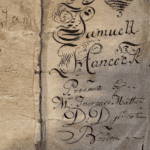
A significant early find came in 2007 with the unearthing of the Phillips Diary. You can see two pages of that on the screen here. The Phillips Diary is a 500-page volume of church records written by the pastor in Rowley, Massachusetts, beginning in the 1660s. This record book had gone missing sometime in the 1980s or 1990s and was rediscovered when a local bank closed.
In 2009, Dr. Cooper located the first Congregational church in Natick, Massachusetts’ records. Those are the other records on the screen. Those records cover the years 1721 to 1794, a crucial period when white residents largely dispossessed the Indigenous population of Natick. The Natick records were the first collection of church records digitized and made available on the Congregational Library website.
The website that was developed in March 2010, as you can see here, was a very basic beginning place for putting digitized records. This is what the website looked like 15 years ago. And there at the very bottom, you can see the link to the First Congregational Church of Natick, the first records that were put on the website.
The work of collecting and digitizing records accelerated after 2010. More records were located and greater attention was given to how records could be made accessible through digitization and transcription.
During 2011, the project obtained a large collection of documents from the First Congregational Church of Middleboro. This is how the digitization work progressed, and here’s how the website looked around August 2011. So in this year, they obtained a large collection of records from Middleboro, Massachusetts. And these records included church relations written by people seeking membership in the church. And they’re an especially valuable set of records because they provide unparalleled access to the religious lives and beliefs of church members, including some African Americans who joined the Middleboro Church during the 18th century.
In 2012, the project team launched their transcription project. They invited volunteers to help them create accurate transcriptions of the Middleboro records, and Helen Gelinas began working as a Transcription Coordinator.
By 2014, records from 17 churches and individuals were online and more were added on a regular basis. Two years later, 2016, records from 34 churches and individuals were available on the NEHH website.
The project expanded dramatically in 2015 when it received the first of three consecutive major grants from the National Endowment for the Humanities and a grant from the Council on Library and Information Resources. NEHH began partnering with more libraries and institutions, including the Colonial Society of Massachusetts and the New England Historical Geological Society. Dr. Cooper began full-time work as the Director of NEHH, and Helen Gelinas became Transcription Director.
Working in partnership with numerous libraries, archives, and museums, churches, and other cultural institutions, the NEHH team and staff at the Congregational Library uncovered valuable and too often overlooked firsthand accounts that preserved the voices of early New Englanders.
NEHH has been sustained and enriched through the efforts of volunteer transcribers who dedicated work to unravel the intricacies of early modern handwriting and made these records more accessible to the public. Today, the collection has grown to a digital archive with 130,000 digital images and over 26,000 pages of transcriptions from 160 historic New England churches and over 100 collections of personal papers.
This project recently embarked on a new stage of work funded by a fourth National Endowment for the Humanities grant. So the project now under the leadership of Dr. Tricia Peone will continue to grow as we move into the future. And so now I’m going to hand things over to Tricia, who’s gonna describe a little bit about how the digital exhibit developed.
TRICIA PEONE: Thanks, Richard.
So the exhibition we want to share with you tonight came about as part of our efforts here at the CLA to commemorate this important 20th anniversary of the New England’s Hidden Histories project. So we’re hoping to highlight some of the individuals and stories that have come to light as a result of 20 years of New England’s Hidden Histories.
When we started sort of brainstorming and conceiving of this online exhibition, Richard and I reached out to people who have worked on the project over the years and people who’ve used the project and the documents in the project in their research and asked them to choose one manuscript, choose a favorite, and contribute an essay for our online exhibition. So these contributors have allowed us, many of whom are here in the audience tonight, have allowed us to showcase the work of scholars, church historians, and transcribers who have all contributed to the project over the years and uncovered new histories as part of this work.
So the result that you’ll see tonight is an exhibition that explores a lot of that really important research that has come out of the New England’s Hidden Histories digital archive and also hear stories that explain how these documents and this research has had an impact on community histories and how we understand Congregational churches in early New England.
So this is the opening page that you can see from our digital exhibition, NEHH@20: Re-Examining Stories from New England Communities. And it includes 13 essays on items in the NEHH digital exhibition. And they’re organized chronologically, starting in the 1650s and going up through the 1830s. I want to thank all of the contributors for this exhibition. Richard and I have both contributed essays in addition to these 12 others whose names you see on the screen and whose essays I encourage all of you to read. We’ll talk about some of them tonight, but they’re really well worth your time to read through.
So we’re gonna start with sharing some of these stories with you tonight, and I’m going to turn it now back over to Richard to talk about our first one.
RICHARD: What you see here is the first essay in the online exhibition. Several of the essays throughout the exhibition address the connections between Congregationalism and politics, including debates about church governance, direct advocacy for the Massachusetts Royal Charter, support for the American Revolution, and the 19th century anti-slavery movements.
The first essay gets right to the heart of mid-17th century ecclesiastical politics and theology of church governance. This essay was written by Samuel Jennings, who is a PhD candidate and a high school teacher. And he wrote about a document titled “An Answere of the Elders to certayne doubts.” It was largely written by Richard Mather about 1651.
The Cambridge Platform, drafted between 1648 and 1651, eventually became the central text outlining Congregational church polity. But, not all puritans and other Reformed Christians entirely agreed with the document when it was produced. This “Answere of the Elders” document in Richard Mather’s hand answers 71 questions and objections to the Platform. Maybe if people were writing today, they would come up with even more than 71 objections. 71 was what the objections were at the time.
It was a formal written defense of the Cambridge Platform. Jennings shows that, “in defending the Synod’s work, the ‘Answere to the Elders’ provides a snapshot of the relationship between New England clergy and the Presbyterians and reformed anticlerics in puritan New England’s churches. The document depicts a strained and terse relationship with Presbyterians and Presbyterianism, while also demonstrating the New England clergy’s elaborate attempt to persuade New England churches and the anticlerics within them to accept the Cambridge Platform.”
Now I’ll hand it back to Tricia for… the next two essays.
TRICIA: Thanks, Richard.
So we are a mere two days away from Halloween, and what could be more fitting than to think about witchcraft in Massachusetts?
So you might be thinking that I would talk about the Salem witch trials, but this essay here is about a much less famous, in fact very little known, case of witchcraft that also took place in Massachusetts, but a few decades after the Salem witch trials. And so this is an account written by Ebenezer Turrell, who’s the minister in Medford, Massachusetts. And the essay was written by Helen Gelinas, the Transcription Director for NEHH.
And so this story, this account of this witchcraft story written by the minister in Medford, he writes it in 1728 and he says he writes it as told to him by a member of his congregation. So he says he’s inspired to write this account of witchcraft based on a case that involved three sisters who were attending his church. They had lived in Littleton, Massachusetts, which is where the events took place, and then moved to Medford with their family.
One of them wanted to join the church, and she’s, well, he says that she was so moved by one of his sermons that she had to confess to him about this incident in Littleton that had occurred a few years earlier. And so what she confesses to is that she and her sisters had pretended to be bewitched by one of their neighbors. The woman that they accused of witchcraft was sick and died.
The people in the community were concerned and basically things sort of eventually blew over but maybe not so much because they did move to another town. It’s a strange case. They talk about the girls being transported up to the tops of trees and being on top of the roof as if demons of the air had carried them there.
But our minister, Reverend Turrell, is skeptical of all of this, and he says that one of the sisters confesses to him that they had made the whole thing up. Their neighbor was not actually a witch, and that they were just playing. And so that’s the confession that she allegedly gives to him in 1728.
And he writes this account of her case. The moral being, the moral of the story being that while he rebukes his community, he tells people that they shouldn’t be reading fanciful novels, that they should not be looking at fanciful novels or anything that depicts witchcraft or the occult. He says that people need to remember the lessons of Salem. He puts the blame basically on the people who believe in witchcraft. He says that it’s superstition, basically.
So his account is giving us this interpretation of witchcraft in 1728, decades after the Salem witch trials, in which he puts the blame on the children involved and in their community. And the ultimate lesson being that they repent and are sorry. And the girl does, young woman does join the church.
So a really interesting case, and this account was digitized as part of NEHH. And the original is at American Ancestors, if you want to ever see it in person.
And when we think about marriage records in Congregational churches, we are usually thinking about records of the act of marriage, records of families joining together, records of the ministers marrying people. But what we have in this case are a little bit more unusual, and they provide a pretty rare opportunity to read an 18th-century woman’s words and her feelings, which she does not hold back on in her letters about her marriage.
So the reason why we have these documents, and what they are is several letters to the people involved in this case and the minister. And we have them because when Mary Tilden leaves her husband, Stephen, the Congregational church, their church gets involved. They form, the church forms a committee to look into the matter. And they solicit testimony from witnesses, and they make decisions. They actually vote on the state of Mary Tilden’s marriage.
And so they generate these documents as paperwork. And that is what has survived and come down to us are these records of a case. But it’s so rare to be able to see an 18th-century woman, this is in 1730s, talking about her marriage in this way, right?
So this is a time when it would be very unlikely, almost impossible for a woman to get a divorce on her own. So what Mary Tilden does is she simply leaves her husband’s household. And the testimony that we see in these letters from some of the people who are questioned by the committee, what we see are someone who tells the committee that Stephen, her husband, was violent towards their children. One of the witnesses says, “that Stephen was,” she said, “I thought he had the least tenderness that I’ve ever seen in any man in my life.”
Mary herself writes a couple of letters in this case about her experience. And she says that she has left her marriage because her husband has committed the sin of fornication with a woman named Sarah Ellis. She tells us that he travels a lot, and she believes that he is sleeping with other women on his travels. She says she fears, “that I shall have sum distemper brought home to me.” She mentions that two of her children have died recently. There was a sickness, some kind of sickness in their community, and two of her children have died. Her grief is so heavy that she’s stopped eating. And now she’s also had to leave her home.
So it seems like for some of this time, she was living with her brother because the minister then writes to Mary at her brother’s house. And the minister, Solomon Williams, is writing, and he says, he tells Mary that the church committee has met, and they have voted. The church says that you need to appear in public before the congregation next Sunday and apologize to your husband and then go back and return to living with him.
Mary does not respond to this letter. Instead, her brother responds to the minister, and her brother says, Mary is gone. She left town. I don’t know where she is. And we don’t have any other record of what happened to Mary after this case. What we have are just these letters about the dissolution of her marriage, and the way that the community steps in to both judge but also to try to reconcile this family, and it’s unsuccessful.
So it’s a really interesting case in that we have Mary’s words and we also have this failure of the church in this case to maintain a relationship, to have that control and that authority over people’s lives that in this case could not be reconciled.
I’m gonna turn it back over to Richard for our next document.
RICHARD: Four of the exhibition essays focus on the complex relationships of Black and Indigenous people to Christianity and Congregational churches’ role in maintaining slavery and settler colonialism.
As my essay contribution, I decided to write about two pages of baptismal records from the Old South Church in Boston. I’ve had a long-time interest in these records. I think they were the first records that I looked at at the Congregational Library for my dissertation research, which was years before they were made readily available on NEHH.
These two pages list 63 baptisms that were performed at the Old South Meeting House in Boston between October 1741 and August 1742. Most of the entries list a child’s name and their parents’ name, such as Anna of Hugh and Mary Vance. Throughout the 18th century, baptizing children of adult church members and children of adults who owned the church covenant was a common but immensely significant ritual.
Churches were the primary record keeper of births and deaths, so these registers have been essential for genealogists. And NEHH provides unparalleled free access to thousands of pages of baptism and membership records. In fact, lists of baptisms organized by date are among the most common items contained in the NEHH archive.
As we look a little bit closer, these two pages of records are important for another reason as well. Ten of the people, nearly 16% of the people listed on these two pages, were people of African descent. While Black people were baptized and joined this church throughout the 18th century, these two pages mark a particularly large concentration of Black baptisms.
Following the revival preaching of George Whitefield during the Great Awakening, unusually large numbers of people joined Old South as full members, or by owning the covenant, including a noticeable increase of enslaved Black people. However, Old South’s embrace of revivalism was not the only factor that influenced their participation in churches. All of Boston’s 18th century Congregational and Anglican churches baptized Black people. In fact, more than 250 people of African descent were baptized in Boston’s predominantly white churches during the 1730s and 1740s.
Ten Black people whose names appear on these pages were enslaved when baptized, and only a couple of them ever gained their freedom. Seven adults: Scipio, Thomas, Pompey, Flora, Dinah, Lucy, and Katherine, were listed as servants to other individuals. Servant was the contemporary synonym for slave. They were legally held as property, but they all owned the church covenant for themselves to be baptized.
The other three Black people were listed with their parents’ names and without reference to a white enslaver. The baptisms of Charles of Scipio, Anne of James and Anne, and Katherine of Cornwall and Katherine were noted in a way that suggests the parents’ desire for their children’s baptism and the recognition of the parents’ responsibility for their spiritual development. Scipio and Sylvia had seven children baptized at Old South between 1741 and 1759. Charles was the first of their children to be baptized there.
These baptismal records and many, many other records listed on the NEHH Black and Indigenous Research Guide are important sources for understanding the connection between race and religion in New England. Collectively, the actions of hundreds of enslaved people attending services, seeking baptism for themselves and their children, being married by a Congregational minister, served as witnesses to the lives they sought to build for themselves within the oppressive system of slavery.
We’ll move on to the next essay I want to highlight. This essay that I’m gonna summarize focuses on Indigenous New Englanders’ engagement and adaptation of Christianity during the 18th century.
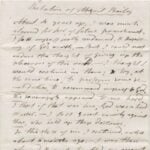
Pictured here is a letter, although it’s very hard to make out the words on it. The ink has faded. It’s a letter written by two white ministers. They wrote it to solicit donations from, “Christian friends in Great Britain and Ireland.” They solicited funds for the expansion of Rev. Wheelock’s Indian Charity School in Lebanon, Connecticut.
This essay was written by Anthony Trujillo, who is a PhD candidate at Harvard University and past recipient of the American Congregational Association-Boston Athenaeum Research Fellowship.
One of the things that I so appreciate about this essay is how he analyzes the important silences and omissions of this document so that colonial figures and the colonial project are not, “at the center of the inquiry.” The letter contains condescending perceptions of Indigenous people, but for Trujillo, it also prompts numerous questions about Indigenous people, their engagement with colonial schools, and their engagement with Christianity.
Here are some of the really thought-provoking questions that he asks in this reflective piece about this letter. And these are quotations. How might participating Native communities have understood the place of Christianity and colonial-style schooling as elements constituting modern Indigenous nations? How did Native people engage with colonial institutions and religion in ways that were no less intellectually rigorous or spiritually consequential as their white New England counterparts? In fact, perhaps even more so because these borderland figures were attempting to reconceptualize and reorient colonial forms towards Indigenous thriving.
We might need to find the… where might we need to find the perceptions of the Indigenous women who agreed to send their children to the school and the Native girls who attended. There’s other questions as well that I think are equally thought provoking in this essay.
The picture on the screen here depicts Sansom Occom, who was a Mohican man and Presbyterian minister. While Occom was unmentioned and unnamed in this letter, he in fact was far more successful than these two letter writers in raising money for Wheelock’s school expansion. However, after it turned out that that money was not going to be used to expand Indigenous education, Occom voiced disappointment and anger when Wheelock reappropriated the funds to establish Dartmouth College as an almost exclusively white-serving institution.
And with that, I will turn it back over to Tricia.
TRICIA: Our next essay is written by Ken Minkema, who is one of the founders of the New England’s Hidden Histories project. And this is about a sermon about the Boston Massacre which is in the collection of the CLA. And we don’t know who the author of this sermon is, but NEHH includes quite a few pretty remarkable stories from the period of the American Revolution like this one, and we’ve also… so this was… We’ve recently digitized about a hundred manuscript sermons from the CLA’s collection that are all from this period, from the era of the American Revolution.
And I encourage you to read the whole essay, but also to take a look at the transcription. So this manuscript sermon, and actually the letter that Richard was just speaking about, have also been transcribed by our contributors who’ve written these essays. So this sermon, it’s about 24 pages of it, have been carefully transcribed by Ken Minkema.
And you can read this sermon if you want to hear what people were hearing from the pulpit in this era. This is a great chance to do so. So the Boston Massacre takes place in March 5th of 1770. And it was a shock. You can see the image that we’ve also included in the exhibition is the image, Paul Revere’s famous engraving, which is a little bit one sided. It’s certainly a piece of political propaganda, but it was a very effective one at turning sentiment against the British.
So in this essay that Ken writes about the sermon, he reminds us that sermons were one of the major ways that people in this period, people in early New England in the 18th century, one of the major ways that they got their news. It’s also how they learned to interpret the news in terms of their faith. So the unidentified preacher who writes this sermon in Boston, probably somewhere in the Boston area, is writing it in the days immediately following the incident. And if you’ve been to the Congregational Library, you know that we’re located with, just on the, just kind of next to the back end of the Granary Burying Ground, where the victims of the Boston Massacre and a monument to them is.
And so thinking about what Boston was like in those days afterwards, certainly a lot of tension. The minister here urges his listeners, urges his congregation, towards repentance and reflection. So it’s a message about looking to God, certainly.
He starts by asking God to revive us again. He’s taken his text from Psalms and is identifying the people of New England with the ancient Israelites, asking them to look within and to reflect on what kinds of sinfulness God might be punishing with this, the country in this, in the crisis that they find themselves in, in the days after the Boston massacre.
So he urges his congregation to repent, but also to reflect. And then he says that he’s kind of a conciliatory message. Ken tells us at the end of the sermon, the minister is conciliatory. He is… he says that the colonies are not looking for independence from Great Britain. And he may have changed his mind later on over the coming years. We don’t know because again, the sermon writer, the minister is unidentified.
But it’s really just a remarkable view to have of the sermon that someone wrote in the days after such a powerful sort of watershed event in early American history. And this is just one of about 100 sermons that have recently been digitized from this period from all over New England that you can read.
I recommend that you do and take a look at the transcription so you can see, because this is actually, you can see the image of the handwriting there. It’s not too bad, but many of these are, you know, they’re old and brittle sermons, and it is nice when they are transcribed and you can see and read them a bit more easily. And that’s one of the most wonderful things about the NEHH project is how accessible it makes these sermons and all of these writings to us now through transcription.
I’m going turn it back to Richard now.
RICHARD: The final exhibition essay takes us to the politics and activism of the Antebellum era. Dr. Jaimie Crumley is an Assistant Professor of Gender Studies and Ethnic Studies at the University of Utah. Some of you are likely familiar with her research and public programming about Black and Indigenous members of the Old South, or excuse me, the Old North Church, with Old North Illuminated.
Here, she writes about the Salem Female Anti-Slavery Society records. Dr. Crumley situates these records in the context of 19th-century Salem, Massachusetts, a place she notes as being, “home to notorious slave traders and leading Black anti-slavery activists.” About 50 women of color in Salem formed the Salem Female Anti-Slavery Society in 1832. Women were leading advocates for abolitionism in both Britain and the United States.
But some male abolitionists disagreed about the question of women’s leadership. In Salem and elsewhere, women formed their own anti-slavery organizations. The authors who created this document, who formed this organization, are clear about their purpose and the religious obligations motivating their work. They wrote, “as moral and responsible beings, as those upon whom the law of love is given, in the sacred scriptures, is binding. They are obliged to lend their individual and united influence in favor of immediate emancipation.”
These records provide details about how women such as Clarissa Lawrence, Susan Caroline, and Maritchie Remond organized and led activism against slavery and also for equal rights. These records are also an example of how NEHH expanded over time to include a broader array of manuscripts leading up even into the antebellum, pre-Civil War era.
For me, overall, the essays in this exhibit show how NEHH digital archives reveals not only personal struggles, strained and broken relationships, and inequalities, but they also reveal moments of spiritual fulfillment and joy, moments of reconciliation and compromise, and Congregationalists’ pursuit of justice.
Now, I’ll hand things back to Tricia for kind of a wrap up before we head to questions.
TRICIA: So I want to encourage everyone to take a look at all of the essays in the exhibition. We’ve highlighted, I think, six tonight, but there are 13 of them to read. So there’s a lot more amazing, really, truly remarkable stories and wonderful essays by our contributors to read through.
And they, and as you see, they span this period… Richard started with Richard Mather’s piece from the 1650s all the way up through the Salem Female Anti-Slavery Society records in the 1830s.
So we’ve got nearly two centuries of items in NEHH, and they’re all quite fascinating. They give us women’s voices. We see information about Indigenous communities and their responses to Congregationalism and missionaries. We find out about Black voices and anti-slavery voices. There’s remarkable stories of the American Revolution in there. And so just so much really rich material that you can see through this project in the digital archive and also through these really wonderful essays from our contributors.
So please do take a look through the whole exhibition and read the essays. And now we’d love to answer questions.
KYLE: Well, that was fantastic. Thank you so much, Tricia and Richard for giving us this wonderful introduction to what you’ve pulled together here.
So we’ve got a good 10 minutes for questions. I’m never at a loss of questions, so I’m gonna jump right in.
You’re both folks who’ve kind of come into this project at different times in its growth. And you’ve seen kind of the initial vision, but you’ve also helped guide where it goes. And I wonder if you could talk a little bit about the focus on manuscripts instead of print. You know, you’ve given us wonderful examples here, but what do manuscripts have to tell us that might be different than a printed sermon or a 19th-century printed history of the records of a church? What, you know, they’re harder to read. Why should we go back to them?
TRICIA: I think the fact that they’re harder to read makes them more fun. But seriously, I think there’s something about the materiality of them interacting with something that you know was held and created by the person whose words you’re reading. And I think that there’s a certain joy that comes with that as historians. It is a way of speaking with and interacting with a record from hundreds of years ago.
And I think manuscripts often, and there’s so much more you can read into a manuscript. In Ken’s essay on that American Revolution sermon about the Boston Massacre, he talks about, you know, you can see where the minister crossed out some words. What was he, did he change his mind? You know, did he make a mistake, or did he want to strike a more conciliatory tone? You know, did he read, he wrote an angry sermon first, and then, you know, did he cross it out and write in something else? And when you can see that in a manuscript, it really does change your interpretation and your appreciation of it. If you can see, did the author, did she change her mind here? What was going on? And you can, you can get a sense of that. And it’s, you know, you can also smell the paper and the ink. It’s just a more sensory experience, I think, than print.
RICHARD: Yeah, think the printed sources are incredibly valuable too, but they have omissions. They have things that are missing and sometimes quite significant things that are missing. Even if a historical manuscript has been transcribed and published, doesn’t necessarily mean that it was transcribed to the standards of which the transcription work that NEHH does.
So for example, there are lot of 19th-century published lists of church members, published lists of baptisms. And genealogists made these, and churches made these, and sold them. But a lot of those 19th-century published lists omitted the racial notations that were in the original manuscripts. And so if you looked at, you know, the 19th- or even early 20th-century published church lists, you wouldn’t necessarily see any evidence that there were African-American or Indigenous people participating in these churches in 18th century. And you have to, in some cases, go back to the originals to see that.
I’m thinking about Lemuel Haynes as well. There’s a biography of Lemuel Haynes that was published in the 18th and included some great letters that Lemuel Haynes wrote to his colleague who ended up writing and publishing the biography of Lemuel Haynes. Lemuel Haynes was the first African American Congregational minister in New England. And NEHH found the originals. No historian knew about these original letters. No one knew that the originals had survived. And in the process of collecting church records from across New England, this project found the originals.
And then we could compare the original Lemuel Haynes letters, which are just also just amazing kind of to hold, right? They’re the letters he wrote, the transcriptions. And, you know, there was some cleaning up of the spelling and the punctuation, but there’s also two really juicy bits of information that the transcriptions left out. Lemuel Haynes had a very low opinion of Thomas Jefferson. And, you know, so one of the comments against Thomas Jefferson was left out of the book. And he also really didn’t like Methodists. And he wrote some kind of scathing critiques of Methodism that were not published. So without that manuscript, we would, you know, we wouldn’t know those pieces of information.
KYLE: He was a staunch Federalist. So I think… But maybe there’s many other reasons for him to have disliked Jefferson, too.
So wonderful questions here from our virtual audience. Our good friend, Amantha Moore up in Newburyport asks, are you continuing to collect early church records? And I guess I would embellish that. Is this your victory lap? Is the project done? Is mission accomplished? Or is there more out there?
TRICIA: There’s always more out there, and yes, we are always interested to hear about people’s early Congregational church records that they might have, whether they’re in their church, or in a bank vault, or in an archive, wherever they might be. We’d love to know about them. Amantha, I know about the records that you have. I’ve seen them up in Newport, and they’re wonderful, and they’re records that we certainly would like to get into NEHH.
So, please, anyone in the audience who knows of some of early Congregational church records, get in touch, and we’d love to start talking about digitizing them and have that conversation.
KYLE: And maybe I can add our wonderful board member, Jesse Garner’s question. Where are these manuscripts preserved, and how have they come to light over the years? Where were they found?
RICHARD: Yeah. So the two I mentioned, the Rowley, Massachusetts, a church historian had died who knew where they were, and nobody else apparently knew. And they were listed as kind of missing in the 90s. And this became a very sort of sorrowful piece of information in the town. People talked about it. People wondered where they were.
And then in, I think 2007 in a neighboring town, community bank was closing, and they were cleaning out the rest of the safe deposit boxes. And a bank employee found a bag with a very old, large book in it with handwriting that for them was nearly impossible to decipher. Someone at the bank remembered hearing about the missing record, and they reached out to the church and the church reached out to Dr. Jeff Cooper and Kenneth Minkema who came up, rushed up to see, are these the missing records? And in fact, were.
The Natick records were locked in a safe, I believe, in the, somewhere in the church, modern church’s facilities, but no one had the combination. It took a locksmith and actually eventually breaking open the old safe to get these original records out.
I have seen 18th-century church records held in a storage closet in a church office. I’ve seen them in some pretty scary conditions where they’re not going to necessarily last hundreds of more years. In Connecticut, most records from Congregational churches in Connecticut before 1800 were collected by the state archive. So Connecticut’s Congregational church records were more centralized.
But for the rest of New England, there it’s kind of a mix of things. Sometimes they end up at a public library. Sometimes they end up at a state historical society. Sometimes they are unfortunately lost.
KYLE: You know, Tricia, now you’re doing wonderful work to kind of expand to other areas that have been less represented, right? So it looks like Rhode Island and Vermont will be, both be coming online, multiple churches from there. So thank you for that work and expanding these.
Great question here from Max Grant, the chair of the board, who says, are there examples of transcribed materials that were originally authored by women or people of color themselves, as opposed to materials that were written about them?
TRICIA: Yes, one of my favorite collections that we have at the CLA are the papers of a woman named Mary Counce. And some of her writings are on display right now in our Sacred Rebellion exhibition that you can come and see, book a tour, come and see it at the Congregational Library. But her collection of papers is remarkable because she is a woman who learned to read and write. You can tell from her hand, though, that she was not particularly well off. You can tell from her spelling that, of course spelling wasn’t as standardized in the 18th century. But you can tell that she does not have the refined hand and the more refined spelling of a man of her generation who would have received a much better education than she did.
And so you get a real glimpse at, you know, she’s spelling the way that she speaks. She’s writing phonetically. And her poetry is from the heart. It’s not, you know, she’s certainly read a lot of poetry, but… you know, it’s not for, she’s not writing poetry for a public audience. She’s writing it for herself in her diary. And so we have, we have her diary, we have notes of sermons that she heard in the Boston area in the 18th century. We have, you know, she writes in her diary about feeling like she is a sinner, like she is worthless. And then we have her letters from the siege of Boston, when the British are occupying Boston. And we have these remarkable letters, where she really seems to kind of find herself and find her purpose and feels that she’s been divinely preserved through this crisis in Boston.
So yes, we do have records that are written by women and speaking about their experiences directly. The Mary Tilden case, those letters that Mary writes are written by her about her experience too, that I was speaking about earlier.
RICHARD: The church records that have relations of faith have a lot of material written by women. In fact, NEHH probably is now the largest concentration of 18th-century writings by women, American women, anywhere. For African Americans and Native Americans, there are some, but it’s much, much, much fewer. And there are some of those relations, and you can find those on the Black and Indigenous Research Guide and a few other types of records.
TRICIA: And one I’d point out too, if I can, is I want to just point out the records of the Abyssinian Church in Portland, Maine. That’s an exclusively Black congregation in the 19th century in Portland, and their records are digitized from the Maine Historical Society and are in NEHH. And you can read those, a Black congregation in the Antebellum period in Portland.
KYLE: Let’s see if I can squeeze in a few more of these wonderful questions. So one of our, the great Congregational historians working today, Rick Taylor, asks, will the project ever expand to look at early Congregational churches such as in Long Island, or New Jersey, or South Carolina? Which I know, and Rick won’t be mad at me for, he’s a little self-interested because he’s writing a great book right now on the mid-Atlantic and Congregationalism.
TRICIA: If I could put on the hat of Edmund Andrews right now, I would say that technically New York could be part of New England, the super colony, the dominion of New England. This was the late 17th century. And therefore, I think we have a justification, especially for Long Island, as being part of New England. And why not? And I’m being a little facetious, but I do think we could branch out to the mid-Atlantic. Certainly.
RICHARD: There are some Long Island churches, particularly Eastern Long Island churches that began as Congregational churches and then much later became Presbyterian. So I think it makes a lot of sense to expand the borders of New England, or expand the borders of this project a little bit.
KYLE: We can call it vast early New England.
So a final wonderful question here from Charlie Hambrick-Stowe, who under his leadership, this project really got going and got many of these grants. Asks, could you reflect on the ways that the documents preserved in NEHH illuminate both continuity and change within the Congregational experience and witness over time?
I think a really wonderful kind of final question for our two great historians. Continuity and change, what are you seeing here?
RICHARD: I’m thinking back to the first item I talked about about the Cambridge Platform, and the fierce independence, autonomy, self-governance, liberty, embodied in Congregational churches seems to me, at least… extends from the early 17th century up to the present. I think that the Congregational form of church governance and its spillover effects on culture is an incredible piece of continuity within change, but also something that kind of gets celebrated in our exhibits about the American Revolution and Congregationalism as well.
KYLE: Well said. Beautiful.
Tricia, any final reflections before we thank everyone for joining us tonight?
TRICIA: I think that, I just to add on to what Richard said, I think there’s also that, there’s certainly a spirited debate that happens in the seven… that’s consistent, that is continuity throughout the 200 year period that the project covers, where congregations are very willing to engage in debate on the social issues and the religious issues of their day.
KYLE: I mean, I want to thank everyone who’s been involved with this project in any way, from the churches that have lent their records, to the transcribers who have sat at their dining room tables night after night poring over often impossible to read old handwriting, to the agencies that have funded us for restoring humanity.
You know, it blows people’s minds when I’m talking to folks at gatherings of churches and academics that for many early New Englanders, the only mark that they have in the historic record that we still have is in a church record, right? That they didn’t end up listed anyplace else. So that they were there, and we see them in these records. And it’s the dedication that both of you have brought to this and everyone else that we actually can bring them forward, completely free, no paywalls, right? You can find your family. You can find somebody whose experience might be a little like yours reaching out towards you in them.