
The World of Mary and Roger Williams
You’ve heard of Roger Williams, but how much do you know about his wife, Mary?
Roger Williams, an English immigrant to New England, was famously banished from the Massachusetts Bay Colony in 1635 for his “new and dangerous opinions” on religious freedom, the separation of church and state, and Indigenous land rights. Following his banishment, Williams settled the town of Providence with the permission of the Narragansett Sachems, creating a colony that was arguably the freest in the western world.
The traditional narrative centers Roger Williams as a lone “hero” in the founding of Providence, but none of it would have been possible without his wife, Mary Williams. For years at a time, Mary was the head of the Williams family, and she played a central role in colony affairs. Part of the challenge of telling Mary’s story in her own words is that she left behind so few of them, especially compared to her husband.
As this program highlighted, Dr. Carrington-Farmer shines new light on Mary and Roger Williams in her recent essay “More than Roger’s Wife” in the New England Quarterly (2024) and her anthology, Roger Williams and His World (2025).
LINKS TO RESOURCES MENTIONED IN THIS VIDEO:
Do you have a question about materials in our collection at 14 Beacon? Get in touch anytime at ref@14beacon.org.
MARCH 19, 2025
KYLE ROBERTS: Good afternoon. Thank you for joining us. My name is Kyle Roberts, and I’m the Executive Director of the Congregational Library & Archives.
Welcome to today’s virtual book talk, “The World of Mary and Roger Williams,” with Dr. Charlotte Carrington-Farmer.
To begin, I want to acknowledge that the Congregational Library & Archives resides in what is now known as Boston, which is in the Place of the Blue Hills, the homeland of the Massachusett people, whose relationships and connections with the land continue to this day and into the future.
For those joining us for the first time, the Congregational Library & Archives is an independent research library. Established in 1853, the CLA’s mission is to foster a deeper understanding of the spiritual, intellectual, cultural, and civic dimensions of the Congregational story and its ongoing relevance in the 21st century.
We do this through free access to our research library of 225,000 books, pamphlets, periodicals, and manuscripts, and our digital archive, which has more than 130,000 images, many drawn from our New England’s Hidden Histories project. Throughout the year, we offer educational programs and research fellowships for students, scholars, churches, and really anyone interested in Congregationalism’s influence on the American story.
Now, today’s program offers new scholarship on Mary and Roger Williams, the influential 17th century couple whose lives left an indelible impact on New England. And I’ve been here at the library for almost three years, and this is our first program on the Williams, so I think we were just waiting for the best speaker, which is Dr. Charlotte Carrington-Farmer.
Dr. Farmer is Professor of History at Roger Williams University. She received her PhD from the University of Cambridge and specializes in early American history. Her research centers on, you know, dissent in 17th-century New England. And she’s published book chapters on Thomas Morton and Roger Williams. But really, it’s this new book on Roger Williams and his world, which we’re here to learn about today. And it’s not just about Roger Williams, of course, but also Mary Williams.
When Dr. Carrington-Farmer is not thinking about the Williamses, she is working on her current book project, “Equine Empire: Horses and the Making of the Atlantic World.” She is active in the field of public history and has received funding and fellowships from the National Endowment for the Humanities, Yale University, the Mellon Foundation, and the New England Regional Fellowship Consortium.
So, Charlotte, thank you so much for being here today. I will take myself down and turn it over to you.
CHARLOTTE CARRINGTON-FARMER: Thank you so much for that wonderful introduction. It’s such a joy to be with you all this afternoon to talk a little bit about Mary Williams, and Roger Williams, and the complicated worlds they both lived in.
So I want to start by talking just for a minute or two about how I came to write this particular book and also, as you just heard, publish the article, “More Than Roger’s Wife: Mary Williams and the Founding of Providence,” in the September issue of the New England Quarterly last year.
I feel like, honestly, I can’t get away from Roger Williams, the man. He was the subject of my undergraduate dissertation in the UK, over 20 years ago. He’s been a part of my teaching and my scholarship, you know, pretty much consistently since then. And, as I teach a first-year seminar in the honors program on Roger Williams, it seemed to make sense that, you know, I wanted to write a book that kind of immersed people in his world through the primary sources.
But the work on Roger has been going on for 20 odd years, but the work on Mary is much more recent. And it actually came around pretty much exactly five years ago to this week. Plymouth Patuxent Museums invited me in March 2020 to give a talk on Mary Williams as part of Women’s History Month. And when that invite went out, you know, in January that year, we had no idea that, you know, as the talk approached in March we’d be on the way to lockdown and COVID. And so the invitation from Plymouth Patuxent Museum to think about Mary Williams’ role in Plymouth Colony, but also more broadly, is what directly inspired me to eventually write this article. So I’m really grateful to them for pushing this scholarship.
So I’ll start with a couple of aims with what I was trying to do with the book. As I say, it was really prompted by the teaching I was doing with students. You know, Roger Williams is well written about, and I feel like a lot of it is, you know, not just what we know, but how do we know it?
The book has a really expansive introduction, and it includes a wide range of primary sources, both by Roger Williams, but also about Roger Williams. And I was really keen to include sources by people who really dislike Roger Williams, such as William Harris, and also one of his enemies in England, so Anne Sadleir, who basically wanted him dead. So I wanted to try to set Roger Williams in his wider context from, you know, the famous things about him, but to lesser known aspects too, and enable readers to kind of experience Williams’ world first hand: the good and the bad.
And so when I was casting around for publishers, I, it became clear to me that Broadview would be a really good fit. Their Sources in History Series is about accessibility and readability. And one of the, kind of, defining features for Broadview is that they have these really wide margins that you can see a screenshot from inside the book that allow me to basically bold out key words, both in the introduction but also in the text, and offer explanations, whether that’s around people, ideas, dates, and concepts, too.
And one of the things that I’m really proud about with this book is the inclusion of Indigenous perspectives on Roger Williams life and world. And you can see here in the margin, my good friend Loren Spears, who’s Narragansett and the Executive Director of the Tomaquag Museum, several times throughout the book, she’s interjected in the margin to kind of offer her perspective of the founding of Providence from a Narragansett perspective. And so that was one of the things that I think really makes this book exciting and different.
So I’ll just read a paragraph or two from the introduction and talk about, you know, Roger’s historical legacy before we then kind of think about how Mary’s legacy compares to that.
So, you know, Roger Williams is arguably the most written about person of 17th century New England. Countless books and articles cover almost every aspect of his life, ideas, and legacies. And just when it seems like there’s nothing new to say about Williams, scholars come up with new interpretations that reframe our understanding.
Beyond the academy, recognition of Roger Williams, especially in Rhode Island, is everywhere. There’s a university named after him, where I work, streets, parks, a zoo, and a dedicated Roger Williams National Memorial administered by the National Park Service. While Williams never sat for a portrait, sculptures and artists have drawn on all kinds of inspiration, from the baseball player Ted Williams to surviving descendants through the very active Roger Williams Family Association, to imagine what he looked like.
And you see a few of these on the screen here. You know, and there are statues based entirely on these imagined depictions of Williams all over Rhode Island; in the US Capitol, you see here; on the Reformation Wall in Geneva; and indeed on a postage stamp. And this is the statue in… on the east side of Providence where his remains are. And this is the one that’s on our university campus.
But Williams’ life was complex and multifarious. But most histories of Williams focus on his most famous or infamous moments: his banishment from Massachusetts Bay, relationship with Indigenous peoples, and advocacy for religious freedom and the separation of church and state.
Some traditional biographies of Williams depict him of being ahead of his time, both in his dealings with Indigenous peoples and his call for religious liberty. But as the sources in this book show, that was not the case. Williams was not a man out of his time, or indeed ahead of them. While he had many remarkable ideas and founded a revolutionary colony, his feet were very firmly planted on the English or Narragansett earth on which he resided.
This collection enables you to consider Roger Williams from different perspectives, from that of a religious radical who was banished and had his books burnt, to a husband who missed his wife.
The sources are a mix of Williams’ personal correspondence, unpublished work, but the collection also includes sources by his contemporaries, which help frame Williams in his wider world. The sources show the diverse worlds in which Williams lived, from a place of idealistic religious liberty, to the very real tragedy of Native exploitation.
This book is an introduction to reading Roger Williams in his own words, a springboard to reading the original documents. As Williams hoped of his Key Into the Language of America, this collection also aspires to be “a little key to open a box where lies a bunch of keys,” a gateway to learning more about Roger Williams and his world and his own words.
So we know a lot about Roger Williams as the intro to the book suggests. But what of Mary? Writing in the early 20th century, Edmund Carpenter, in his biography of Williams, simply said, “who was this lady? It’s not known, save that her name was Mary and that she proved to him a true and loyal wife. The record is meager.”
And that’s a fair assessment. We have only one surviving copy that’s known of Mary’s handwriting, which I’ll show you a little bit later this afternoon. And so when we’re writing about Mary, I’ve had to be really creative with the sources that I’ve used, using what other people are saying about her and to her to help build a picture of what her life was like compared to her husband, who has hundreds of letters which have survived and several published accounts.
But what I argue in the chapter in the book, and also in the standalone article on Mary, is that Mary actually played a very important, if overlooked, role as a head of the family. She faced numerous challenges solo in New England when Roger was away, whether that’s doing diplomacy work, trading in Indian country, in England on charter business.
And, you know, for almost half a century of marriage, Mary was alone for months of the year at a time and even a couple of years whilst Roger returns to England, and so she plays a really important yet overlooked role.
So you can see from the table of contents, there’s a pretty robust introduction. And then the book kind of picks up with Williams’ story in England. So I want to start with a little bit of kind of a chronological approach and set Roger and Mary in their 17th-century context in early England.
So Roger was born in the Smithfield district of London around 1603. It’s not clear exactly when he was born or baptized because his baptism records, which would have been held at his parish church, St. Sepulcher-without-Newgate, were destroyed in the Great Fire of London. And Williams himself reflects on his age a couple of times during his life, but the dates don’t add up. So he kind of forgets how old he is. But our best estimate is around 1603.
But we know that his mother was Alice, and his father was James, and he has three siblings. And his father is a merchant tailor, essentially trading in elaborate cloth. And it’s possible that his father took the young Roger down to the River Thames as the ships were coming in from all over the world. And, you know, young Roger Williams learned, you know, how to be a businessman, how to be a trader from his father. And you know, that’s the occupation he goes on to have eventually in Rhode Island when he sets up his trading post in Narragansett homelands.
Now the district of London that Roger grows up in is Smithfield. And I’ll show you a 17th century map here that shows the area. So this is the kind of Smithfield district. Fabulous 17th century spelling here. You can see the purple building here is Roger’s parish church, St. Sepulcher-without-Newgate. Williams’ house was along here just on what is now, what is described here as Cow Lane. And you can see his high school here is identified as Charterhouse.
The Smithfield district of London, the map shows one of its, kind of, famous roles as a market site, as a trading site. And in fact, still today it’s the home of a fish market. But it was also the site where, for many years, religious heretics had been burnt alive. And I think this long and bloody history has an impact on the young Roger Williams.
And one of the things, again you can see a screenshot of the book here, that I kind of argue is to try to understand the specific neighborhood of Smithfield where, you can see here the image of John Lambert’s execution. Williams would have been well aware that from, you know, the time of Henry VIII and the Reformation, how England switched between being Catholic, and Protestant, and everywhere in between, different people were being executed for their religious beliefs. And that could switch on the time of a monarch.
And so I think, you know, growing up in this neighborhood where different people are being executed for whatever the whim of the monarch is, has an impact on the… on Roger Williams. And some of the sources in the book include Williams reflecting back on the executions at Smithfield.
I’ve been lucky to actually go back to England… I’m obviously British, but I’ve been lucky to go back to England twice with my students to lead short term study abroad trips retracing Roger Williams in England. And one of the sites that we always visit is the parish church of St. Sepulcher-without-Newgate.
You can see a little me holding a little Roger Williams statue in front of the church as it is today.
But one of the interesting things inside the church that’s on display right now is the execution bell that was installed when Williams was a young boy. And because St. Sepulcher was the closest site to both Newgate Prison and also the execution site in Smithfield, this bell would be rung from Williams’ parish church as people, you know, made their way to the execution site. And when Williams was a young boy, Bartholomew Legate, basically, who was a Separatist, was held… was described as, you know, as a heretic and burnt to ashes. And this bell was the one that was rung.
We also know that a couple of years later, Thomas Helwys was held in Newgate Prison when Williams was a, you know, a teenager, approximately. And he rotted away in Newgate Prison for arguing for the very thing Williams went on to argue for, but also built in Providence. And, you know, that was, “that the magistrate is not to meddle with religion or matters of conscience, nor to compel men to this or that form of religion.” So it gives this sense of the kind of complex area Williams grew up in that had a long and bloody history of persecution.
When Williams was a young boy, he came under the mentorship of Sir Edward Coke, who went on to be the Chief Justice of England. And Coke paved Williams’ way to study at both Charterhouse school and eventually Pembroke College at the University of Cambridge.
And again, if you ever get the chance in, to be in England… This is an image of Charterhouse as it stands. And you can tour it. I highly recommend it. And they have a little plaque to Roger Williams.
So Williams time, I think, at Pembroke is very important. You can see a slightly later 17th century image here. And then me just putting a little statue of Roger back in the college a few years ago. But his time at Pembroke, I think, is when we start to get a sense of his religious leanings and how he has moved, presumably, away from the established Church of England and has moved towards a more puritan ideology.
One of the things that was really cool as I was working on this book, was to spend some time in the Pembroke College archives, looking at their matriculation records. And, I spent many happy hours actually looking at these records, looking through hundreds of them. And believe me when I say these matriculation, these college entrance records, are incredibly formulaic. They are all written in Latin. The date is always underlined, and there’s always just a couple of sentences describing who the pupil is, you know, how old they are, or where they’re coming from, and if any particular person is sponsoring their place.
And after looking through countless of these records, it became clear that Williams was really the only anomaly in these records. And you can see his entry is here. You can see that the date’s not underlined. It just says Williams and a full stop. There’s a gap, and then someone in a different hand has entered another student’s information.
And… what is going on here?
And, you know, I have a couple of theories, right? Like it’s not evident. Maybe the registrar was just having a really busy day that day and thought they’d come back and enter Williams’ information. Maybe they just didn’t have it to hand. Or maybe by this point, Sir Edward Coke, Williams’ mentor, has fallen out of favor with the King and eventually spends some time in the Tower of London.
So, is that it? I mean, Sir Edward Coke is a Trinity student. He’d gone to Trinity himself. And so it got me thinking about, you know, why did Williams go to Pembroke, not Trinity? And again, the incredible archivists at the Pembroke College Library helped me track down some of the scholarship documents that enabled Williams to study there.
And I’ll just show you a couple of the interesting pieces. So the… Williams was able to study there as part of a scholarship due to his ability to make verses in Greek and Latin, his competent skill in the Hebrew grammar.
There was also a geographic element to the scholarship. So, the scholar had to be from the City of London. But this also caught my eye too, “the poorest to be preferred.” So, you know, in modern day terms, it was his academic ability, but also his financial need, that opened the gate to study at Cambridge.
And I think his time at Cambridge transforms him. So after thinking about Williams, about Roger Williams, I want to kind of think about what we know about Mary Williams’ early life in England.
So unlike Roger, we actually have a baptism, a christening record for Mary entered in the records of Worksop in the East Midlands of England in Nottinghamshire. Here’s the 17th-century map of Nottinghamshire. This is where Mary was most likely born. This is the gatehouse of Worksop Priory. Here’s me, stood in front of Worksop Priory a couple of months ago.
And Mary then grew up in the Priory because her father was Richard, was Rev. Richard Bernard, who was an incredibly important puritan clergyman, and I spent a bunch of time looking into this for the article and parts of the book, who, even though he’s a clergyman at Worksop Priory and later in Batcombe in Somerset, he is clearly puritan, and flirts with separatism, and is networking with all of the people who eventually play an important role in the founding of Plymouth.
And so he is, I think, really interesting to consider in terms of when Mary comes over to New England, and especially during her time in Plymouth, the people there would have known Mary through her father. But more importantly, by this point Richard Bernard has done a full 360 and has uneasily conformed to the Church of England and has published pamphlets basically attacking his former separatist friends. And so, again, if you’re curious about Richard Bernard in the Q & A, I can certainly talk more about him.
And he actually, one of the things that we see is we don’t know what Roger looks like or Mary, but we do have this really great image of Richard Bernard. And I always joke with the Roger Williams Family Association, who graciously made me an honorary member a couple of years ago… You can’t trace your Roger Williams looks, but you have a clear sign of what the Mary Bernard side looked like.
And so this is probably Richard Bernard, Mary’s father’s most famous work, The Isle of Man. But he also publishes on a really wide range of things. And I teach a class on witchcraft. And one of the things I actually teach is Mary’s father’s book on witchcraft, The Guide to Grand-Jury Men, which is essentially, you know, an examination of witchcraft cases in England and, you know, how to identify and punish witches. So, again, if anyone’s curious of witchcraft stuff, I’m happy to talk about that in the Q & A.
So Mary and Roger’s paths met when Mary left home to take a job at Oates Manor in High Laver in the south of England, in Essex, and when Roger left to take a job in the same household. Roger had recently graduated from Cambridge, and he takes a job working at Oates Manor as a private chaplain.
And one of my favorite things is that Roger’s earliest surviving correspondence is from this particular moment, from the spring of 1629. And it’s not letters, you know, writing about religious freedom that have survived, or separation of church and state, or anything kind of theological, although some of it is. Part of it is love letters to another woman, a woman called Jane Whalley, who is also in the household. And he’s writing to Jane Whalley’s aunt, Lady Joan Barrington, essentially asking for Jane’s hand in marriage. The letters are included in the book.
And, Lady Joan Barrington basically tells Roger Williams, no way. You are not of high enough status. And then Roger rather ungraciously responds back saying, she’s old, she’s gray, you know, her hourglass is running out. And so he does not take this rejection well, it’s fair to say.
And just a couple of months later, so this is, you know, April, May 1629. In December that year, he marries Mary. And you can see the marriage record here. And so I’m not saying Mary’s his rebound, but she is maybe, you know, she’s there to nurse him through this rejection.
And Roger and Mary are married in the parish church in the village of High Laver. And the church still stands today. Here’s a picture of a couple of my students from the last time we went. And here’s the interior of the church, which is fascinating in a study in and of itself and how little it’s changed since they were married in the early 17th century.
And here’s Tina, the churchwarden, you know, telling us all about this. As a note of interest, actually, John Locke is buried in the church. Locke spends time in the village later, after Roger and Mary have migrated over. But his tomb is on the exterior of the church.
So the next chunk of the book, and what I’ll talk to you about this afternoon is, you know, following Roger and Mary as they make their New England calling as they cross the Atlantic Ocean.
So from those letters from 1629, Roger described how he had, “a New England call to the ministry in Boston.” He later reflected the reason he left England was because of a push factor from Archbishop Laud, who pursued him out of this land. And his conscience was persuaded against the bishop, and the national church, and ceremonies.
He is also offered the job as the teacher of the Boston church. And I also wonder if continuing to work in the household where he’s just been rejected from marrying Jane Whalley is part of that push factor, too. And again, I’m thinking about Mary’s father’s connections in England. Was that also part of that push factor over here?
So, Roger and Mary arrive in Boston in 1631 on the Lyon. And it’s fair to say that their first few years in New England are full of turmoil. They crossed the Atlantic for Roger to take this job. He immediately gets off the Lyon and starts to criticize the church in Boston. You know, say many different things, but particularly that it is really no better than the Church of England that they’ve all just crossed an ocean to leave behind.
And so very quickly, he moves north to Salem. From Salem again, he just can’t seem to settle. And he moves further south to Plymouth, which, obviously is well known for its separatist connections, originally founded in 1620.
But again, I want to think about the fact that Mary’s father knew many of the people in Plymouth from his time in the East Midlands in England. So again, I wonder if part of that pull down is Mary’s connection. Because most, many of the people in Plymouth would have known Mary when they moved down there.
Roger and Mary lived for two years in Plymouth. They had their first child there. But again, after a time, Williams becomes increasingly critical, even of the separatists in Plymouth. And he and Mary relocate back north to Salem.
And by October 1635, it’s clear that Roger Williams is not going to be able to stay within the Bay Colony. And famously, in October of that year, he is banished for having, “new and dangerous opinions,” advocating that religious liberty, religious freedom should rule, that church and state should be separate.
But also he has controversial ideas on Indigenous land. He goes as far as charging the king with, “a solemn public lie, committing a sin of unjust usurpation upon others’ possessions.” And at the time… a little bit later, sorry, William Hubbard goes as far as to say that Williams had spoken dangerous words against the patent, the, basically the governmental foundation of Massachusetts Bay. So all of these things make him a liability to keep.
Now, it’s not an easy decision to banish Roger. They spend, you know, a long time trying to debate with him, trying to persuade him to change his ideas. And he just won’t do this. And, what’s really interesting to think about is the timing.
So, again, let’s flip to Mary’s story. So as Roger is banished in October of 1635, what’s clear is at the same time, Mary is exerting her power to make her own religious decisions. And we have a couple of sources, both are from a little bit later, that describe what’s going on in the Williams family household.
So, Nathaniel Morton basically describes how Mary continued to participate in services in Salem after Roger had stopped attending. And as a result, Roger “refused to pray nor give thanks at meals with his own wife, nor any of his family, as they went to the church assemblies together.” And we also have another account from Cotton Mather that basically says that Roger would not hold any communion in any exercise of religion with any person so much as his own wife that went along to their assemblies.
So what adds to the complexity of the situation is that Mary was heavily pregnant at this point, as this played out, and she gave birth to their second child, Freeborn, in October as her husband was banished, and as she is, you know, refused to… as Roger is refusing to basically pray with her in the family home.
And again, I think we focus so much on this famous moment from Roger’s perspective. But Mary’s perspective was very different. So let’s follow Roger and Mary now as they build Providence.
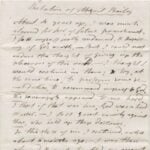
So the document on the left then is probably one of the most famous documents in the early history of Providence. It’s described as 1636/1638 Land Evidence, where Roger Williams was able to not just theorize about Indigenous land rights, but to kind of put that into practice.
The document is really small. You know, it’s kind of this big. You could see that parts of it are missing. It’s clearly been folded, you know, where there’s a tear in the middle. But I think it’s really important for a couple of reasons. It shows then the boundaries of the town. But it also shows the two Indigenous sachems, the uncle and nephew duo, Canonicus and Miantonomi, signing with their marks to this agreement along with two other Indigenous witnesses. Again, I think it’s one thing for Roger to theorize about, you know, the king taking land is not the right thing to do. But it’s another thing for him to then put that into practice.
And one of the really interesting things in the book is, this document’s included, is Loren Spears gives her commentary as to why, you know, what her interpretation is as to why the Narragansett nation would allow Roger Williams and his small group of followers to settle at this key location in Narragansett homelands. And how, you know, from a Narragansett perspective, the Providence settlers would have been a tributary to the Narragansett nation. And so I think it’s really interesting to consider this settlement from both an Indigenous and a Eurocentric perspective.
One of the other documents that’s in the book and in the article, though, is this later description of the boundaries for Providence. So in the 1660s, there’s a massive amount of land disputes in Providence about, you know, who’s residing where, what the boundaries of the town were. And so in the Providence records, they basically in this source kind of clarify how Providence was founded, you know, the role Roger played, you know, how it was acquired. And Roger famously said, you know, it was nothing but love that could have purchased Providence. But, you know, as we hear from a Narragansett perspective, it was more of a strategic alliance and trading partnership.
Well, what’s fascinating about this particular document is the bit at the bottom, and I’ll show you zoomed in here. In the 1660s, when they’re looking to clarify the boundaries for Providence, they come to Mary Williams for her to clarify this. And she signs with her mark.
And again, we don’t have the written record, but if they’re coming to Mary in the 1660s to say, hey, what was the deal with the founding of Providence? It seems reasonably likely that she was there, too, in the 1630s, as they were navigating and negotiating the original agreement with the sachems, with Canonicus and Miantonomi.
And again, I think this is buried away in the records that we think about Roger in the defining moment. But Mary’s moment later on, clarifying and maintaining Providence is equally important.
So I think Providence is pretty special. It allowed the Williamses to put their new and dangerous opinions into practice. There’s no established church, although Williams is eventually involved in the first Baptist church, which again, I can talk more about in the Q&A if people are interested.
And what’s radical is, you know, in Providence, you don’t have to worship at all. The initial compact describes how matters concerning public good are made by major consent, and the government authority is only in civil things. And these are reaffirmed when Roger goes retroactively back to England to get approval from Parliament, which allows full power and authority to govern and rule themselves. So essentially saying sole liberty can rule.
So Roger goes back to England twice, and the second… so the first time is in the 1640s. He goes back again in the 1650s. England is a real mess in the mid-17th century. Obviously, Charles I is executed. We have Oliver Cromwell in power for a period of time. And so, you know, dealing with a small colony across the Atlantic of radicals does not seem to be the most important thing in the 1640s and the 1650, certainly.
It’s the work of John Clarke, who is often overlooked, who even though Williams goes back for a couple of years in the 1650s, it’s John Clarke who stays to retroactively get the document that you see on the screen, the 1663 Charter for Rhode Island, which when the monarchy was restored in 1660 and Charles II eventually takes the throne, basically clarifies what Williams had been putting into practice for 30 years at this point.
And the charter, which you can see a small excerpt on the screen, if you ever get the chance, is on display at the Rhode Island State House in the Charter Museum. Compared to the 1636/38 Land Evidence, this is massive.
And I’m reliably told by the state archivist that this image was what was used to inspire Disney’s Captain Hook. And so now I’ve seen that, I can’t unsee that. So I want you to see that, too.
But more seriously, the Charter “described how it was a lively experiment with a full liberty and religious concernmeant. Nobody could be molested, punished, disquieted, or called in question for any differences in opinion in matters of religion.” And so it reaffirms what Roger has been living with for the last 30 years in the Charter. And I think this is probably one of the most important documents in the book and in the founding of Providence.
One of the things that’s really interesting is to think about some of these ideas that Williams is banished for. And one of them is obviously his advocation for separation of church and state and religious freedom. And Williams writes at length about this in his personal correspondence.
But perhaps his most famous work on this is The Bloudy Tenant of Persecution that he publishes whilst he’s in England the first time. And you can see the front cover here. I’ve read this book many times, and I feel every time I read it, I leave with a headache. It is not an easy read. It’s over 400 pages where he’s using reason, politics, religion, history, and his own experience to advocate for these ideas.
Probably one of the most famous lines in The Bloudy Tenant is, “God requireth not a uniformity of religion to be enacted and enforced in any civil state. Christianity can flourish anywhere. The government of the civil magistrate extendeth no further than over the bodies and goods of the subjects, not over their souls.”
And as you can see, you know, there’s no publisher or name on here. The book wasn’t licensed. It wasn’t submitted for the censor or approval. It sold rapidly. And it’s ordered to be burnt, both by the public hangman and also by parliamentary servant. But it’s so popular that many pamphlets in the, you know, 5 or 6 years after directly address this.
So let’s take a reality check. I’m going to talk for another five minutes, and then we’ll have a good 15 minutes for questions.
So Williams was not an enlightened, proto-liberal running around the New England wilderness, as much as we might want to paint him that way. He’s not a multiculturalist before that even becomes a thing. He’s not supporting religious freedom because he’s open minded or enlightened. He is, I think it’s fair to say, a religious fanatic, by early modern standards and even modern standards, too.
It’s not a romantic story, the founding of Providence. You know, Williams is banished. The Bloudy Tenant was burned. His neighbors fought. He had to live alongside those he’d despised. You know, lived reality of religious freedom is complicated. His colony was viewed with contempt. His long-term acquaintances, like Anne Sadler, wished him dead. Eventually, his house burned down in King Philip’s War. He lived his final years in poverty.
But he was successful, right? He used theology to advocate for the right of others to worship. You know, whilst other people theorized about religious freedom and had a few experiments with toleration, Williams went further, both in practice and along with much further than some of his more famed contemporaries, such as Milton, Hobbes, and Locke did.
And he created this geographical space where people could live those principles out, for better or worse. And he had the instrument of civil government to protect these ideas of religious liberty. And it’s possible that Providence was the freest place in the Western world at this moment.
Mary’s role, then… In the last few minutes, we’ll talk about Mary and some of Roger’s Indigenous ideas as we wrap up.
Mary was a commanding presence in her own right. She held the mantle of leadership during Roger’s frequent absences. And as I mentioned at the start of the talk, we only have, at this point, one surviving copy of her… of her handwriting that’s held at Mass Historical Society, where she writes on an unsent packet, “For my dear and loving husband.” “Roger Williams,” is scribbled out. “At Narragansett,” is scribbled out, too.
So, you know, how do we tell Mary’s story when we have so few surviving words of her own? One of the sources that I use in the book is this publication, Experiments of Spiritual Life and Health, that Roger published whilst he was in England the second time. In here, he publishes a letter that he sent to his wife, “MW,” Mary Williams, upon her recovery from a dangerous sickness. And Williams uses the letter that he’d sent to Mary in publication form to basically gift her this publication as a way to kind of address her sickness as she’d recovered whilst he was away, through the lens of the Bible. And so it’s a really fascinating publication. And again, I can talk more in the end.
So for Mary, then, we also have evidence that when Roger’s in England, certainly the second time for a couple of years, he’s desperate for Mary to join him. And he writes back to Rhode Island saying, I, you know, “I tell her, Mary, how joyful I should be of her being here with me until our affairs were ended. And I freely leave her to wait upon the Lord for direction. And according as she find her spirit free and cheerful, so to come or to stay.”
But Mary decides to stay in Providence, even though Roger begs her to join him.
And the second letter comes a little bit later. Again, Roger, writing back from England, He says, “remember, I’m a father and a husband. I’ve longed earnestly to return with the last ship. Pray you consider, if it not be convenient that my poor wife be encouraged to come over to me. I write to my dear wife the great desire of her coming while I stay, yet left it to the freedom of her spirit. No man can stay here, as I do, without much self-denial.” But Mary remained steadfast in her decision and stayed in Providence.
The last point I’m going to make in the last minute or two is to think about some of Roger’s interactions with Native peoples, which take up a significant amount of my work.
So in the book, I discuss at length Roger’s most famous publication, A Key Into the Language of America. But I also think about Williams as a Narragansett language scholar, interpreter, trader, scribe, diplomat, captor, and eventual enslaver. And Williams published A Key Into the Language whilst he was in England for the first time.
And as you can see here, in its most basic form, it is an English-Narragansett phrasebook and dictionary. And it includes probably some of his most favorable lines, where he says, “boast not proud, English, of thy birth and blood. Thy brother Indian is by birth as good.” So in God’s eyes, Williams argues, everybody is equal.
And he takes that further with his publications: Christians, not… “Christenings Make Not Christians,” where he basically says that converting Native peoples is not the right thing to do. He is truly fearful of a false conversion, which is why when John Eliot translates a Bible into Wampanoag and sets up the praying towns, Williams remains steadfast in his belief that conversion is not the answer.
Now, the final point I want to leave you with is probably one of the most complicated ones. Thinking about Williams’ relationship to slavery, Williams writes multiple times in correspondence that, you know, he’s against perpetual slavery. But after the King Philip… after the Pequot War in 1637, you see the quote here, where he’s writing to John Winthrop to request a boy to come live with him. He says, “I’m bold. If I may not offend in it, to request the keeping and bringing up one of the children. I fix mine eye on this little one with red about his neck. But I will not be preemptory in my choice. But will rest in your loving pleasure for him or any, etc..”
Winthrop writes back, “Sir, I desire to be truly thankful for the boy intended. His father of Sasquat, where the last fight was and fought not with the English as his mother, who is with you and two children more certified me. I shall endeavor his good and the common good in him. I shall appoint some to fetch him, only I request you would please give a name to him.”
So the state of… the status of this boy is unclear. The term I use in the book is “unfree.” It’s not clear if he’s indentured or enslaved. And there’s no law on slavery on the books in Rhode Island until the 1650s. And Williams later references. “Will, my Native boy.” So it’s likely that this is the boy.
And then finally, in the wake of King Philip’s War, the document you see here is Williams selling Native peoples into slavery in the Caribbean, directly profiting from that.
KYLE: Thank you so much, Charlotte. That was fantastic.
And you know, you’ve taken somebody with a life that can take up hundreds of pages, and you’ve done a great job of giving us 45 minutes.
CHARLOTTE: I made some hard editorial decisions this morning when I was deciding what to include and what to skim out.
KYLE: I’ll start with, you know, you’re in a… as a public historian and as an educator, you’re in a, you know, a good position to try to understand what we do with the inheritance of this kind of memory of Williams, And seeing how it lands, I guess, or how it can have contemporary relevance. And, you know, what I appreciate is you don’t, you don’t hold back from the contradictions.
And I wonder if you could just talk a little bit about your time being at, you know, an eponymous university for this person, you know, for Roger. Although maybe after this, maybe we should get them to call it the Roger and Mary Williams University, given that she probably spent as much time, if not more, in that region than she… than he did.
But, you know, how do you wrestle with the contradictions when you’re talking to the student, to the neighbor?
CHARLOTTE: You know, and that’s such a good question.
I will say that the administration at Roger Williams University have been incredibly supportive as I’ve taken on this work. We’re having an event on campus next week, and they are encouraging me to talk about the difficult stuff of slavery, too. And so the university has been really transparent in wanting to share this, the good and the bad of the legacy.
And so, that really has enabled me. And that might not be the case, right, if it was a different university, and a different state, and a different person. So that’s been really liberating, too.
I’m an honorary member of the Roger Williams Family Association. I do a lot of work with them. We have their archives on our campus. And we’ve had some really difficult decisions, and conversations around this. But again, my sense is that people are not looking to paint him as a good person or a bad person, right? They understand our role as historians is to share the sources, not just what do we know, how do we know it? And then how can we work together to interpret this, to understand that he’s a complicated person living in a time of upheaval both in England and New England.
So, you know, I’m not saying it’s easy all the time, but I’ve been encouraged by the conversations I’ve had so far.
And I do a lot of public history work with the Rhode Island Slave History Medallions. And again, that’s really helped me have some of these difficult conversations with the public. And especially with the current goings on, you know, I think it’s important to try to continue to have these conversations as transparently as we can as historians.
KYLE: 100%. Yes, absolutely.
So great question here from Sara Georgini, who I think you know, one of our board members. She says, terrific talk. I loved hearing about the cultural memory contrast when it comes to how we remember Roger and overlook Mary.
Can you tell us about any public history initiatives to reinterpret and reintroduce Mary?
CHARLOTTE: Well, Sara, that’s an incredible question. And the answer is, I can. So, we’ve got three really important ones that are going on.
So, you saw some pictures of Worksop Priory, Worksop Priory in Nottinghamshire in England. I’m collaborating with them to put an interpretive plaque to Mary in the grounds of the Priory.
I do a lot of work with Roger Williams National Memorial through the National Park Service. And we’re working on putting interpretive plaques up at the park to tell Mary’s story.
But perhaps most excitingly is, I’m a board member of Rhode Island Historical Society. And they just told me that at the John Brown House in Providence, they’re gonna dedicate a whole room to Mary Williams’ story that will go up this summer, and will be up for three years.
And so, you know, in the article, I kind of lament oh, you know, there’s nothing for Mary. And then here we are, like a few months later after that’s come out where, you know, really important public facing places are starting to tell her story. So I’m really excited to be sharing that information with you today.
KYLE: Fantastic. I’m gonna put together a couple questions in this next one because everybody’s buzzing about Anne Hutchinson. So…
CHARLOTTE: Who isn’t?
KYLE: So Helen Gelinas asks, is there any mention of Roger Williams’ reaction to the arrival of Anne Hutchinson and company, also banished from Massachusetts Bay? Did he have contact with her?
And, Charlie Hambrick-Stowe asks, is there any record of a relationship between Mary Williams and Anne Hutchinson? And if their, you know, depending on what we do or don’t know, do you have any sense of how they might have related or viewed one another? What would Mary have thought of Anne’s theological and spiritual perspective? And there are some other Annes, but I’ll let you kind of…
CHARLOTTE: I’ll talk briefly about, so Anne is on my radar, too.
One of the pedagogies I use is reacting to the past, where students live in a historical moment. It’s a pedagogy pioneered by Mark Carnes out of Barnard College. And in my Roger Williams seminar, we actually have Anne Hutchinson’s trial in the class for a whole month. So I feel like, if I can’t get away from Roger Williams, Anne Hutchinson is close behind.
So I gave a talk, actually, last year for Women’s History Month at Rhode Island Historical Society, comparing Anne Hutchinson and Mary Williams because they grow up, I don’t know, 20 miles apart, in Lincolnshire and Nottinghamshire. They’re immersed in similar worlds as they’re growing up.
But their… how they’re remembered is so different. And obviously that’s because Mary is not famously banished like Anne. And it’s her husband who is.
And so we have no correspondence between Mary and Anne, but the worlds they grow up in the East Midlands are very, very similar. We have no recollection of what Mary thinks of Anne when she’s banished, when she settles in Aquidneck Island.
You know, Roger, I think is obviously sympathetic, given his own recent experience. And again, I think we forget the chronology, that it’s really soon after Roger is banished that Anne comes that following year. And so, I think he’s deeply sympathetic to her plight.
And again, one of the things that I talk about in the book is that, you know, that’s the complexity of the lived reality of this, right? Like, even if Roger disagrees with people, whether that’s, I don’t know, William Harris, or the Quakers, or Samuel Gorton, he allows those people to settle, for better or worse.
And if anyone’s interested in Anne Hutchinson, please do check out the reacting to the past trial of Anne Hutchinson book and pedagogy. It’s an incredible way to immerse yourself in her world firsthand.
KYLE: Fantastic.
So Duncan Ness asks, how important was Roger and Mary Williams’ relationship with the Winthrops, Senior and Junior?
CHARLOTTE: Oh, that’s such a good question. Yeah. Really important.
So it’s John Winthrop who tips Roger off when he is banished. Roger’s banished in October, but, you know, they give him some time. Mary’s just had their child, you know, winter’s coming, he’s sick. But because he continues to meet many, actually, many of the women come into his house. They move to arrest him that winter.
And it’s Winthrop who famously tips him off that they’re gonna come, and they’re gonna banish him to England. And it’s Winthrop who, you know, steers his course to Narragansett Bay. And, you know, for the first, you know, decade or so, Roger Williams and Winthrop correspond, and we still have a lot of their correspondence. And in fact, a lot of Roger’s correspondence is at Mass Historical Society because it’s in the Winthrop Papers.
And Mary’s surviving copy of the handwriting is in the Winthrop Papers because on the back, Roger writes to John Winthrop, Jr. in Connecticut about an issue of the death penalty for adultery. So that correspondence is still there.
And again, for Mary, I didn’t have time to talk about this today, but there is a glimmer of her relationship where Roger writes, you know, my wife sends her best to your wife. My wife sends some chestnuts, and she’ll send some more if she likes them. So we get these glimmers of not just Roger’s diplomatic connections, right? Roger is heavily involved with Winthrop, certainly through the Pequot War and onwards with playing that in… that diplomat in Indian country. But those social connections through Mary, too.
KYLE: More questions coming in. We’re not gonna be able to get to all of them, but I’m gonna try to throw out as many as I can.
So, Richard Pickering asks, is there any evidence of a connection between Susanna White Winslow and Mary Williams as women of husbands who knew each other and whose husbands left them in New England for extended periods of business in New… in Old England?
CHARLOTTE: Yeah. So, Richard is actually the deputy executive director of Plymouth Patuxet Museum, and he and I are good friends. That’s an incredible question, Richard.
It’s possible. It’s not something I’ve looked at.
You know, you were the one, Richard five years ago, almost to the day that prompted this article on Mary. So perhaps five years from now, we’ll be looking at an article that examines that specific thing.
But it’s possible, but it’s not something I’ve come across so far in my research. But it could well be out there. And it’s a really interesting thing to think about.
KYLE: Great.
Another possible source or thing to think about from Lori Rogers-Stokes. She asks, have you read Mary’s narration of her spiritual experience as recorded by Thomas Shepard?
CHARLOTTE: Yeah.
KYLE: In the first person and full of fascinating personal details.
CHARLOTTE: Yeah, it’s a great source. Thank you for flagging that, time was a little bit tight today, but, yeah. Thank you.
KYLE: So here’s a great, you know, a great question about what you do as a scholar as you think about Roger’s upbringing.
So, Dr. Wesley Brown asks, what do you think about the details concerning Roger’s upbringing, the dynamics of his family life and his parenting? You know, is there a place for you in your work to think about kind of psychohistory, you know, or… That’s Dr. Brown’s words, not mine. But, you know.
CHARLOTTE: I love it.
No, I’m teaching for the first time in a few years, the historiography and methodology class. And psychohistory is one of the things we’re covering next week. So it’s relevant.
I, it’s not an avenue I’ve explored yet. But, I mean, I am such a social cultural historian, right? Like, you know, of course I’m interested in Roger Williams, the leader and the big ideas he has. But I’m also really interested him as a husband and as a father. And, you know, what’s life like in their house? And so it’s not something I’ve done yet, but it’s a possibility in the future. And that particular lens of psychohistory is a fascinating one to consider.
KYLE: I think the, I think Mary should get the last word. So I’m going to, as our final question, this is from Carolyn Westgate, who thanks you for this incredible presentation on such exciting research.
So final word, Charlotte. What influence do you think Mary had on Roger’s decisions?
CHARLOTTE: I mean, Caroline is a former student of mine and an incredible high school educator, so that’s a great question.
I think Mary actually played a really, really important role in terms of the connections she had from her father in England and the networks that enabled them to build, to the fact that she’s there in the house when Indigenous leaders and culture keepers are there, like, negotiating key diplomatic agreements.
I think she’s there physically when he’s not, making many of the decisions, maybe without even consulting him because he’s far away. She’s not sure where he is. And I think the fact that she chooses to stay in Providence for two years when her husband is in England shows how driven she is in her own right to kind of keep the colony going.
And I think there’s so much more that I wish we knew about her. But, you know, instead of lamenting that, you know, we only have this, you know, she’s a really privileged white woman. And the stuff we know about her is incredible compared to what we might know of an Indigenous or African enslaved woman of the same time period.
KYLE: Excellent point.
So thank you so much for this presentation today. And please join us again in the future. I’m excited for what, you know… Maybe we’ll have you back when you’re done with the next book and learn about some whole other new part of New England.
CHARLOTTE: Thank you. I appreciate the privilege of being here. And thank you for the thoughtful comments and questions.
KYLE: Take care, everyone.