
Cotton Mather and the Women He Loved
Who was Cotton Mather at home, without the wig?
History has judged Cotton Mather harshly when it comes to women, perhaps with good reason. His first published sermon was preached on the execution day of Elizabeth Emerson, convicted of murdering her illegitimate newborn twins. And Mather’s writings are littered with numerous assertions reinforcing the deeply entrenched puritan notion of the subordination of women. Then, of course, there was the debacle of the witchcraft trials. For these reasons, when people think of Mather today, the word most likely to come to mind is “complicated.”
But who was he as a husband and father? From the reputation that has come down to us, one would assume Cotton Mather to have been a tyrant over his wife and a strong disciplinarian who ruled his children with a rod. Certainly, few would suspect that between wives, he was shamelessly sought after as a highly eligible widower.
In this talk, NEHH Director of Transcription Helen Gelinas takes a look at Mather’s relationships with the women in his life: his three wives, his daughters, his sisters, and his life-long pursuit of the one woman he strove to understand perhaps more than any other, that prototype of all women, Eve.
LINKS TO RESOURCES MENTIONED IN THIS VIDEO:
Do you have a question about the Mather materials in our collection? Get in touch anytime at ref@14beacon.org.
FEBRUARY 14, 2024
TRICIA PEONE: Good afternoon. Welcome, everyone. Thank you for joining us today. My name is Tricia Peone, and I am the Project Director of New England’s Hidden Histories here at the Congregational Library & Archives.
Welcome to today’s virtual program, “Cotton Mather and the Women He Loved,” with Helen Gelinas.
To begin, I want to acknowledge that the Congregational Library & Archives resides in what is now known as Boston, which is in the Place of the Blue Hills, the homeland of the Massachusett people, whose relationship and connections with the land continue to this day and into the future.
For those of us joining us… for those of you joining us for the first time, the Congregational Library & Archives is an independent research library. Established in 1853, the CLA’s mission is to foster a deeper understanding of the spiritual, intellectual, cultural, and civic dimensions of the Congregational story and its ongoing relevance in the 21st century.
We do this through free access to our research library of 225,000 books, pamphlets, periodicals, and manuscripts, and our digital archive, which has more than 100,000 images, mostly drawn from our New England’s Hidden Histories project. Throughout the year, we offer educational programs and research fellowships for students, scholars, churches, and anyone interested in Congregationalism’s influence on the American story.
Please check our website, congregationallibrary.org, to learn more about what we do and for news about upcoming events.
New England’s Hidden Histories is a digital project of the Congregational Library & Archives that digitizes, and transcribes, and provides access to early New England Congregational church records. The project comprises an online collection of manuscript Congregational church records for approximately 1620-1850, including letters, sermons, diaries, relations of faith, church disciplinary cases, account books, and genealogical information. And the project works in partnerships with libraries, archives, and churches to digitize those records.
So far, over 110,000 pages of material have been digitized. And Helen, who you’ll hear from today, and her team of project volunteers, have produced over 20,000 pages of literal transcriptions, all of which are available on our website.
I’m very pleased to tell you that today is our second annual Cotton Mather lecture, which we are going to hold each February near the anniversary of Cotton Mather’s birth and death. So yesterday was the anniversary of Cotton Mather’s death, the 13th, and he was born on February 12th.
So the CLA has a large collection, a very significant collection of materials related to the Mathers. And you can find a guide to materials related to Cotton Mather, both works about him and works by him, published and unpublished, in our research guide, our Cotton Mather Research Guide on our website.
So now please allow me to introduce our speaker today. Helen K. Gelinas is the Director of Transcription for New England’s Hidden Histories. She holds a Bachelor of Music degree from the Hartt School in Connecticut and a Bachelor’s in English and an MA in American Studies from the University of Tubingen in Germany. In Tübingen, she was selected by the Mather Project to be a research and editorial assistant for Volume V of Cotton Mather’s Biblia Americana.
Following the presentation and publication of her essay “Regaining Paradise: Cotton Mather’s, ‘Biblia, Americana’ and the Daughters of Eve,” she earned a research fellowship to the Jonathan Edwards Center at Yale Divinity. She is currently a PhD candidate in early American Studies at the University of Heidelberg, completing her dissertation, which is entitled “The Spirit and the Bride: Female Parity, Prophecy, and the Power of the Pen in the Works of Cotton Mather.”
So thank you, Helen, for joining us today.
HELEN GELINAS: Thank you, Tricia. And greetings to all of you who are watching today.
Welcome to this annual Cotton Mather lecture, as has already been explained well by Tricia and why we hold it this week. But because this year the lecture falls on Valentine’s Day it just seemed appropriate to take a look at the domestic life of Dr. Mather.
Therefore, we will take a short excursion through his three marriages and mention some of his children along the way. I will also intersperse a few examples of Mather’s intellectual and theological processes and developments in refining his understanding of Eve in the Bible and of how women should or should not be perceived in relation to Genesis 3 and to the first woman.
On February 12th, which as you know was his birthday, in 1686, Cotton Mather paid his first visit as a suitor to young Abigail Phillips. As it was his 23rd birthday, he records the significance of the event in his diary: “This day, through the good hand of God upon me, I finished the 23rd year of my life. And this day I gave one of my first visits unto a young gentlewoman, the daughter of worthy, pious, incredible parents in Charlestown, unto an acquaintance with whom the wonderful Providence of God, in answer to many prayers, directed me.”
The couple married three months later on May 4, 1686. Abigail was one month shy of her 16th birthday.
Later, in describing their wedding day, Mather records in his diary, “on the morning of my wedding day, the Lord filled my soul and my heart was particularly melted in tears upon my further assurances that in my married estate he had reserves of rich and great blessings for me.”
Disappointingly, Mather does not mention or describe his bride in his entry. He ever after refers to her in his diaries, though, as “my dear consort.” The couple was extremely happy together. In describing their normal home life, Cotton Mather writes that they established a pattern of evening prayers, followed by communal reading or private study. They then met together for singing a verse or two of psalms and usually ended their day repeating the last verse of Psalm 4, which was a particular favorite of Mather’s. So you can tell that he was very happy in his domestic situation.
A little more than a year later, on August 22, 1687, they joyfully welcomed their first child, a beautiful baby daughter named for her mother, Abigail. But only five months later, the baby of whom they were so enamored, died of an attack of convulsion. This would be the first of many losses the couple would suffer. Of the nine children Abigail bore, five died in infancy or in early childhood.
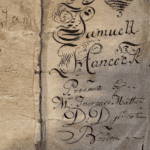
This is the cover page of the sermon that Mather preached for the… for his first child. Incredibly, young 25-year-old Mather wrote and preached his daughter’s funeral sermon and delivered it to the congregation the same afternoon that the baby died. This is hard to understand how anyone could do it. He called it “Right Thoughts in Sad Hours.”
His bereaved wife was not yet 18 years old. He ached for his own and for her deep pain. Some critics who have read this sermon say that is one of the most thorough and helpful sermons ever written for the management of grief. Even today, people look to this sermon.
One good example of how Mather valued women was his desire to correct church discourse regarding the female sex, while not trespassing across the boundaries of orthodoxy. He was determined to remain totally true to the Bible, but he felt that there was a little bit of clean up to do with the way some of the writers had portrayed women… not in the Bible, but on their own.
One finds numerous examples of this throughout his 1692 work for women called “Ornaments for the Daughters of Zion.” But for the sake of time, we will examine only one today. This is an excerpt taken from the text “On the Apparel of Women,” written by Tertullian in the third century. And this circulated for many hundreds of years. I will read it for you.
“And do you not know that you are (each) an Eve? The sentence of God on this sex of yours lives in this age; the guilt must of necessity live too. You are the devil’s gateway; you are the unsealer of that forbidden tree; you are the first deserter of the divine law; you are she who persuaded him whom the devil was not valiant enough to attack. You destroyed so God’s image, man. On account of your desert-that is, death-even the Son of God had to die.”
For too long, Cotton Mather felt that this perception of females was particularly unfair and that all women did not bear this kind of rhetoric and this kind of scathing reduction. He wanted to do something about that. We will see that this is the frontispiece of his work “Ornaments for the Daughters of Zion,” and you will see that right under his name, he includes, “Tertullian’s Advice for the Ornaments of Women,” which Tertullian absolutely despised.
However, what Mather does is he takes only the ending of Tertullian’s tract and leaves out all of that vituperative language and just takes this beautiful, encouraging part: “Go ye forth now arrayed with such ornaments as the apostles have provided for you; clothe yourselves with the silk of piety, the satin of sanctity, the purple of modesty, so the Almighty God will be a lover to you.”
Mather also wrote a little bit of refutation to Tertullian within the work of “Ornaments for the Daughters of Zion.” He waits about 54 pages to do it, but then he literally talks back to Tertullian. He writes, ‘it is indeed a piece of great injustice that every woman should be so far an Eve as that her deprivation should be imputed unto all the sex.” So he does take him on,
but just very subtly.
In 1693, Mather began work on his Biblia Americana, the first Bible commentary written in the New World. This was an important work, and he decided to make it consist of not the same format as other common Bible commentaries. Rather not going verse by verse throughout the Bible and making comments on it, but rather by scanning the writings of all kinds of scholars, from all over the world, from different ages, and from different callings in life, and finding things within these writings that supported the words in the Bible.
And so this was the work he entered into in [1693]. He thought that if he had seven more years, he might be able to finish it. However, we know that he worked on it till nearly the last day of his life.
Returning to his marriage with Abigail, he was able to encourage her and to teach her so that by 1689 she joined the North Church as a full member. Mather praised her piety, her obliging deportment, her discretion in ordering his affairs, and the “lovely offsprings I have of her.” He was very delighted in the children.
As they approached their 16th wedding anniversary, Cotton Mather was thinking that they’d been married a month longer than Abigail had been alive when she came to be his bride. A strange foreboding came over him as he was thinking about this, a sense of impending loss.
And just a few nights later, Abigail miscarried a son in the fifth month of her pregnancy, which began an illness from which she never recovered. It’s assumed that she was already ill before the pregnancy, but… and it’s also pretty well… most people think that what she had was breast cancer, and then it was aggravated by other infections and diseases, which were so rampant at the time.
Mather’s diaries revealed the process of her, of her illness and his strivings with God in prayer. His encouraging times when God spoke to his heart that his prayers for his wife had been heard. Mather called these impressions “particular faiths,” and he wrote about them more clearly in the “Biblia Americana.” They were like little prophecies, he said, hopeful signs that lifted his spirits and encouraged his faith that indeed, his beloved wife would recover. But Abigail languished for five long months. And while… and during those same five long months, Mather prayed, fasted, wept, and encouraged her. To read his diary through these months, as Abigail grew weaker, is absolutely heart wrenching.
She died in December of 1702. Her last words were, “heaven, heaven will make amends for all.” Mather, of course brokenhearted, penned a poem for Abigail using her last words. He posted it, or pasted it, rather, inside copies of “Ornaments for the Daughters of Zion” and distributed them to the many women who had helped in Abigail’s illness and to attendees at her funeral.
And I know you can see it. I’ll just quickly read it. “Go, then my dove, but now no longer mine; Leave Earth, and now in heavenly glory shine. Bright for thy wisdom, goodness, beauty here; Now brighter in a more angelic sphere. Jesus, with whom thy soul, did long to be, Into his ark and arms, has taken thee. Dear friends, with whom thou didst so dearly live, Thy prayers are done; thy alms are spent; thy pains are ended now, in endless joys and gains. I faint, till thy last words to mind I call: Rich words! Heaven. Heaven will make amends for all.”
Mather was now the devastated, widowed father of four young, motherless children. Two months after Abigail’s death, he began receiving letters from a woman in Boston. Although Mather does not name her in his diaries, she has been identified as Kate McCarty. A very forward woman, 23 years old, she impudently asked him to marry her. She was also quite clever. She used arguments she knew would sway him, such as, you are the only one who I know can win me to salvation.
For months, he was tempted, even obsessed with her. His family disapproved thoroughly, including his father. But he could not get her out of his mind. Only the thought that she would hurt his ministry held him back, and still he could barely resist her. His diary mentions the difficulties he had with celibacy, even when his wife had been ill. But with Abigail gone, he was virtually plagued.
What saved him was a widowed neighbor, Elizabeth Clark Hubbard, who lived only two doors away. And she, like Abigail, was a pious woman, very devoted to God, and he knew that she would be an example to his children and to his congregation. They married in 1703, a year after Abigail’s death and had a very happy and productive home life. Six children were born to them in the course of their ten-year marriage, which was unremarkable in that it was so happy.
In the Biblia, and I call that the short cut for saying “Biblia Americana” every time, Mather’s attitudes toward wives, marriage, and children shows itself as gracious and generous, also for the selections he uses to prove that. For one example, consider the question asked by his interlocutor about Eve’s creation.
This is from Volume I of Biblia Americana, Genesis 2:21. The interlocutor asks all the questions throughout the Biblia, and Mather answers them. “Why was not Eve also fetched and formed out of the earth as well as Adam, but from a rib of Adam?” “Athanasius,” Mather answers, “gives us an agreeable reason for it. “That they might not have occasion to say that Adam was formed from one sort of dust and Eve was formed from another, and that the dust of Adam was more excellent than that of Eve, and that the offspring accordingly took their good tempers from Adam and their ill from Eve.” So this is a very egalitarian answer from Mather.
His wife, Elizabeth, unfortunately died ten years after they were married. A terrible scourge of measles and smallpox had attacked in Boston. And of her six children, only two survived their mother. Even when she became ill, she was pregnant with twins. And the twins also died. It was a very, very difficult and sad time.
This time during Elizabeth’s illness, Mather rejected the notion of his particular faiths. He was still very shaken by what he believed had been so solid a way of hearing from God, only to find out that, in fact, he really had misunderstood. And that, yes, God had said he had heard his prayer, which he interpreted it to mean, I have answered and will do for you what you prayed. And he didn’t want to take this on again and shake his faith one more time.
He was a very notably mild and amiable parent, according to some sources. Mather did not approach the rearing or disciplining of his children along the lines so often used by Bible believers then and now of “spare the rod and spoil the child.” On the contrary, he deplored physical punishment and severity.
He wrote in his diary, “the slavish way of education carried on with raving, and kicking, and scourging in schools as well as in families, tis abominable and a dreadful judgment of God upon the world.”
He preferred instead to make his children’s experiences with him so enjoyable that they dreaded most of all, being banished from his presence. It makes one wonder how Mather could have ever produced the staggering volumes he wrote because his children were so often with him. And he was, for all intents and purposes, what we would call today a stay-at-home dad. Except for preaching and for making pastoral visits, he was either with his children or in his study.
I myself have come across pages while transcribing some of the books of the Biblia Americana, where I would find child-like handwriting, practicing penmanship or doing sums. And on one occasion a very elaborate design drawn on a partially empty page. It was always rather charming to find those.
In educating his children, his hope for his sons, Creasy, short for Increase, named for his father, and Samuel, was to prepare them for the ministry. But what is especially remarkable about Mather is the way he educated his daughters, especially his daughter Katherine, who was the eldest surviving child of his marriage with Abigail. Mather was never one to discourage intellect in women and certainly not in his daughters. He recognized in Katherine a particular giftedness. She had a penchant for learning, much like her father’s, and he taught her Latin and Hebrew. She became a mistress or a master, I guess a mistress of the Hebrew language, something Mather was extremely proud of… always talking about her, that she could read the scriptures in the original language. She also mastered what Mather called the sacred geography, which you will find in the Biblia and in his later work, the Triparadisus, the threefold paradise.
She was also good at art in the form of making wax molds, and she was very good at vocal and instrumental music. So she was quite talented. She was kind of the joy of his life. Furthermore, she was pious. She visited the sick and imprisoned, and she enjoyed reading the works of Johann Arndt and other German pietists discovered by Mather in his middle years. After his wife Elizabeth’s death in 1713 and his mother’s in 1714, Mather became somewhat understandably, rather downcast.
He looked, hopefully to the beginning of what he hoped would be the millennium, the return of Christ to set up his kingdom, which he now expected and hoped for in about 1716, as he had once expected it in 1697 and it had not occurred. So it was kind of a low time for him in his life.
In November 1714, a prominent businessman named John George died at the age of 49 in Boston, leaving his beautiful and wealthy wife behind. And this is a little bit surprising for what we think of as Cotton Mather. Within a month of John’s death, Cotton Mather presented himself at her door with his children. This is how Mather began his courtship, just by showing up and introducing himself and his children to her.
This quote that you’re seeing on the screen is from a letter he wrote describing himself. This is, of course, to Lydia, Lydia George, describing himself in the third person as a man who strove to do good, even to those who harmed him, making the case that if that were true, how much more beneficent and wonderful would he be to someone he loved as much as Lydia?
Another excerpt here shows other letters pressing her to consider him. I like this one… The second from the bottom: “I was never got so far into it as I am now, with unspeakable joy… as I now with unspeakable joy, find myself. And now my lovely creature, do you go study my lesson and get beyond me.” And this one: “my (inexpressible!) I am afraid you haven’t been well, because my head is ached pretty much this afternoon. The pain of my heart will be much greater than that of my head if it really be so,” signed, “one who loves you inexpressibly.”
Lydia’s reaction to all of this courtship, and his charm, and his letters was flat rejection. She basically told him, go away, think no more of it. It’s never going to happen. But he was very persistent. I don’t have time to get into all the ways, he had other people contact her and different things.
But in spite of how… in spite of her firm refusals and discouragements toward Mather, on July 24, 1715, both Mather and Lydia signed the following document. I was even a little surprised to find they had prenuptial agreements in those days. But this is how theirs read: “…according,” this was promising that Lydia would have full control of her inheritance that she had received from her father, a very wealthy man when he died, and her husband, who was one of the leading civic and business merchants in all of Boston. But she’s saying that she’s gonna control this money “according to her own mind and will… to empower and employ as she shall think fit. All the lands, tenements, money, goods, chattels, or other estate whatsoever, which of right is belonging, appertaining, or payable under her, and to take receive,” I think they mean receipt, “and dispose of her own use all the issue, profits, benefits, and incomes thence to be made.”
Furthermore, there was the following clause: This is to be done “without any let, hindrance, or denial of the said Cotton Mather.” So he wasn’t to have anything to do with her fortune. And these were the conditions that she set. Furthermore, there was an additional clause not shown here that said that if he did touch any of her fortune, that he would be liable to pay a fine of £2,000, which was something like 20 years’ salary, just huge amount of money. So hands off. It was her money.
In spite of this, Mather was over the moon and romantically smitten and likely would have signed almost any condition Lydia placed or made requisite to their union. Except, of course, I’m sure he would not have signed the Devil’s black book.
He had also signed up to be the administrator of Lydia’s son-in-law’s estate, which was so encumbered with her husband’s that he ended up in charge of that estate as well. I think he was really not paying attention when he agreed to these things. The problem was he had no business experience whatsoever.
For the first year of their marriage, all was well. According to Mather’s diary, Lydia was accepted by his children, and their prayer life was exuberant, as was their private time, to which he often alluded in his diaries.
But things didn’t stay that way.
Immense trials followed about a year, a year and a half after. Mather’s beloved and accomplished daughter, Katy, the one we just talked about with all the talents, languished an agonizing eight months with a kind of consumption. She agonized and her father deeply agonized, and it was very similar to the experience that he went through with his wife, Katy’s mother. He prayed constantly, seeking God for healing for Katherine. He called her his lamb. She was really, really a special child to him. However, it really wasn’t to be. Katherine died a slow and lingering death finally, after eight months of sickness in December of 1716.
But before she died, she wrote down not only… well, they had already had her conversion testimony, but she wrote down literally what is a sermon. And she wrote it for the young people of Boston. And she asked her father, she brought it to him, and she asked her father if he would please read her words at his funeral.
The name of the sermon that Cotton Mather preached was called “Victorina.” And Mather utterly, and utterly brokenhearted did follow her wishes. He was happy to do it because he felt that the young women of Boston, the ones who were particularly spiritually minded, had much to offer and had much to say.
And he was always somewhat bewildered by St. Paul’s prohibition that the women might not speak in the church. This is what he says about that in “Victorina”: “certainly, such an one, is qualified,” meaning Katherine, “such an one is qualified now, to be brought in as a competent witness, to testify unto the pleasures in the ways of piety.”
This is what she urged the young people: make your salvation sure. Do it early while you’re young, there are many pleasures involved. Continuing to the quote, “on the behalf of this young witness, O our young people, you are earnestly called into them. The voice of the dove is heard so calling to you; a dove that has the sun of righteousness now, with what glory! Shining on her, wings covered with silver, and feathers with yellow gold, and strong must be the obstinacy of our young people in their evil ways if they will not receive the testimony.”
So this was empowering. I know that in our century this doesn’t look like that much, but it was a big step for Cotton Mather to read his daughter’s words, her direct words, and allow them to ring out in the church.
But this heartbreak in the marriage between Mather and Lydia was just the first in a long list of shattering trials. Things really got very difficult over the next few years.
Cotton Mather’s son, Increase, for whom he had prayed for his entire life and made many statements in his diaries about how God would use this young man… on the day he was born, he made these statements, was rather wayward and always a bit of disappointment to his father and a worry constantly. And Increase fathered an illegitimate child by a prostitute in Boston. This was beyond what Mather could have ever imagined going wrong.
Furthermore, Lydia, his wife, began to have terrible outbursts of rage against her husband. She was furious about his diaries. She hated him writing about her in there. She stole some of them. She hid some. She refused to return them. She taunted him with it, that maybe you’ll get them back sometime. He records some of these things that she did in the marriage that he called her paroxysms.
And I’ll just read you a little bit of his words: “the consort,” and compare this back to the earlier courtship letters, “the consort in whom I flattered myself with the view in hopes of an uncommon enjoyment, has dismally confirmed it unto me that our idols must prove our sorrows. This last year has been full of her prodigious paroxysms, which have made it a year of such distresses with me as I’ve never seen in my life before. When the paroxysms have gone off, she has treated me still with a fondness that it may be few wives in the world have arrived unto. But in the returns of these vicious paroxysms, which of late still grow more and more frequent, she has insulted me with such outrages that I’m at a loss what I should ascribe them to, whether a distraction,” he really can’t understand what’s going on with her, “which may be somewhat hereditary.” He’s basically asking himself. “Or to a possession, whereby the symptoms have been too direful to mention.” He also wrote, “I have lived for a year in a continual anguish of expectation that my poor wife, by exposing her madness, would bring a ruin on my ministry.”
Other intense trials continued. She became very temperamental with the children, so much so that they had to move some of them out of the house.
And then an economic crisis hit the city of Boston.
The first, and then the thing they dreaded the most happened because he was in charge of the estates of her husband and her nephew. People needed money. And they dreaded the first summoner coming to the door, as did happen, and commanding both Lydia and Cotton Mather to appear in court.
This was not the only time. Lawsuit after lawsuit for debts that were not Mather’s were served on him. And they followed… They followed… They followed and followed and cost hundreds of pounds over the next few years.
Mather was forced to pay off these debts that he had never incurred against both of the estates. Lydia, absolutely still refusing to use money from her large inheritance, would not help him.
Another thing that happened was the smallpox epidemic, for which Mather was much hated in the city of Boston, because, as many of you know, he was a proponent of inoculation, which people thought was just impossibly wrong, against God’s will, and highly dangerous. Someone was so angry about it that they threw a bomb, a veritable bomb into the house and could have killed or blown up the house. And for some reason it did not go off all the way.
Furthermore, Mather was turned down twice for the presidency of Harvard in these years, and this just utterly broke him down. He felt like a failure. He was miserably unhappy.
And Lydia was even more unhappy. During one outbreak where she accused him of not being very friendly or not showing her any friendly looks. He said it was absolutely ridiculous. It’s a whimsy. You are imagining it. And that was enough to set her off so badly that the argument continued into the night, during which, in the dark of night, she left the house with her maid and told him she would never live with him again. She was leaving and never, ever coming back.
This was a very dreadful time for Mather. Now he was alone. His former difficulties, not with the fact that his wife had left the house, but that she had also left his bed, caused him to write what he described as battles with impurities and things like this.
So he was just a man with nobody and just worried about everything. And that was still not the last of their great trials.
A few days after Lydia left, Mather received the terrible news that his son Creasy, out at sea, had been lost and drowned on a voyage back from Barbados to Newfoundland. This was the final blow.
Three days after the news of Creasy’s death, Lydia did return to the house. She knew that this was the final blow for Mather. She knew how well and how much he cared about his son. She was deeply sorry about Creasy’s death. And also, she wanted to make amends with her husband. She begged him to put their past angers into oblivion, and they seem to have done so.
One other terrible financial strain was held over their head. He was basically bankrupted because of these two estates. And he only had one more valuable possession. One maybe at all, ever, one valuable possession. And that was his library. And he was in such dire straits that he knew that he was forced to sell it. Thankfully, members of his church came forward, knowing that to sell his library would just be a second death to him. And they put up the money and did save Cotton Mather’s library.
But all of it had taken a terrible toll on Mather. With Lydia back, he sort of remained in his study a lot. And he continued to write prolifically, producing some of the greatest works that he’s known for in these later years.
He also made numerous entries into the Biblia Americana, even though he knew that it would never be published. He had received word that there was no possibility ever in his lifetime of having the Biblia published just two months before his daughter Katy’s death.
So this was a shattered man.
One might expect that having endured such rages and turmoil with the wife he had so ardently desired, but had turned out to be nothing like the meek puritan wives he was used to, that these upheavals might have negatively affected Mather’s ameliorating interpretations of the first woman, Eve, as he was writing in the Biblia.
However, in the years between 1717 and 1726, Mather continued to procure works written as late as 1726 in England, and somehow getting them over into his study. And from them he was able to draw not only benevolent but encouraging and prophetic portraits of the archetypical woman, as the first to believe God’s promise of a redeemer, not as the source of death, which Tertullian had portrayed her as and had claimed, but rather of life.
This is what he writes, that “Eve was the mother of all living,” which I’ll explain in a minute. The question: “Adam seems to call his wife, Eve, not until after the fall, why not until then?”
And Mather answers: “Before the fall, he called her a woman, Ischa. But now, upon the fall, the promise of the Messiah was made unto her. And hereupon he called her Eve,” or Hava in Hebrew, “because out of her should proceed he that should give life unto all them that seek him. In and by the Messiah, she is the mother of all the living, who brought into the world else none but sinners, and such as without him, are dead in trespasses and sins. Adam, under a threatening of death, expecting that the threatening would be immediately executed, was transported when he heard of being saved from the present execution of it, and expressed his joy by calling his wife, Eve,” or Hava, which means “one that should yet live, and bear an offspring that should also live and be saved.”
As we read the excerpt of this last entry I’m about to show you, which portrays Adam and Eve trembling before God. The serpent has been judged, and they’re waiting for their judgment. One cannot think but that the ensuing scene might have resonated with Mather on a personal level, giving hope and restoration, not only to Adam and Eve, as we will see in the text, but to himself and Lydia, who remained with Cotton Mather until his death on February 13, 1728.
“It was necessary still to give them,” Adam and Eve, “such an hope, as might make them capable of religion toward God.” Not to just cast them out of the gate of the garden. “This hope they could not but conceive, when they heard from the mouth of God that the Serpent’s victory even over themselves, was not complete. But they and their posterity should be able to contest his empire. And though they suffered much in the struggle, yet they should finally prevail, and bruise the serpent’s head, and be delivered from his dominion over them. Now, what could this conquest of the serpent mean? But as the enemy had by soon subdued them, he should be subdued by a return of righteousness. And this must be followed with a recovery of the blessings which they had forfeited.”
Thank you very much.
TRICIA: Thank you, Helen Oh, that was wonderful. Just absolutely wonderful.
So if people have questions, we’ve got a few that have already come in, but feel free to put some questions into the Q&A, and we’ve got some time to ask Helen a few things. We’ve got some great questions coming in.
I want to start, though, by asking you, I think Cotton Mather, I think it’s fair to say, he’s certainly one of the most famous people in early American history, right? If you asked students or even just anyone in the, in… just in the general audience to name an early American puritan, I think Cotton Mather is probably one the top five people that would come up in such an answer.
And yet what most people think about Cotton Mather has been so shaped by the Salem witch trials and how he’s been portrayed in various books: The Crucible, TV shows like the WB channel Salem show, where he’s young and lusty.
So we have this view of Cotton Mather that is really only tied to this, to him in the witch, in the Salem witch trials, right? So if you could rewrite what people remember about Cotton Mather, how would you ask us to remember him? What would be different about the way he appears in public memory, as this stern, scary puritan? How would you rewrite him?
HELEN: So many things come to my mind.
First, I would want people to know that he was eager to please from his childhood on. You know, his life was overshadowed by his heritage, his grandfathers, Richard Mather and John Cotton, whom he didn’t really know. But nevertheless, their presence was still over him. And his own father passed away only five years before Mather’s own death. So he never really got to be an independent person.
As a little boy, he had that terrible stutter. He wanted to please his father. But as I left out of my presentation, I wanted to put it in, but this is one of the reasons Cotton Mather spent so much time with his children. His own father spent 16 hours a day locked up in his study and had very little time with his many children. And I think that between his great desire to please his father, to do what was right, to be a good Christian,
I think that he was tormented, and I think he suffered from that. I think he suffered from that most of his life. He just wanted to do well, and to do right, and to get that approval somehow. And time after time, he got the opposite.
TRICIA: Yeah. Such, such great insights today on… I think you’ve really humanized Cotton Mather so so much different about him that we don’t all know.
So a couple great questions. Our first question, was Mather a catch for Abigail Phillips, his first wife? Did they both come from good families?
HELEN: Definitely. Yes.
Her father was Captain, well, I forget his first name now, but Captain Phillips. He was well known. He was a member of the church. He was a leader in the community in Charlestown, which is, you know, just across the river from Boston. A very highly respected family. And this is the kind of people only that a Mather would have married into, frankly.
This is why it’s such a great departure that he was even tempted by this woman out of the blue who really got in his way and was determined. She even got her mother involved, writing letters, and then she threatened even to expose things about him to the public.
His great fear, his truly lifelong great fear, was losing his pulpit because of some sinful thing or something. So he risked that in these debts. He was afraid he was going to debtor’s prison later when he was married to Lydia. And this was a great fear of his life. And he didn’t want to do anything that would cause damage to his ministry for that reason, including, even though he was incredibly attracted to this beautiful young woman, he just couldn’t do it. So he went with the pious, motherly woman.
And yet you see these same tendencies come back later when Lydia George is available because she was nothing like the kind of women he was used to dealing with.
TRICIA: Wonderful.
So another question that came in is asking about the sense of impending loss of his wife’s death seems surprising. How were premonitions understood as part of Mather’s theological worldview?
HELEN: They were very much a part of Cotton Mather’s theological view.
There are times when he would be preaching as a young man and suddenly have an inner sense that a great tragedy was about to happen. Meanwhile, fire broke out in Boston, and many homes were burned down. They ran out from the church to put it out.
He would have these things. But so did his father. These particular faiths and premonitions were a constant theme in Increase Mather, in Increase Mather’s life. And I’m sure Cotton picked it up over years from living with his father.
TRICIA: Someone’s asked if, you know why he was denied the presidency at Harvard. Did it have to do with his marriage or his debts?
And they say, thank you for a fascinating presentation.
HELEN: Oh, that’s nice, whoever you are.
He lost mainly because one person, at least one person, accused him of not being academic enough.
TRICIA: Oh.
HELEN: I know. And I think that was the most severe part of the blow.
TRICIA: A man who wrote 400 treatises?
HELEN: Yeah. So, and, you know, it was Leverett who got the position. He had always had some rivalries there.
And then later the position opened up again, and he was really sure he would get it this time. Remember, his father had been the president of Harvard for many years. He almost felt somehow, like entitled to it in some manner or other. And then to be told he could not have it because he was just not academic enough was too much for him to take.
And then who did get the presidency was Benjamin Coleman of Brattle Street Church and the former minister of Lydia, because she attended his church.
So it was just knives all round, just crushing him. In fact, he was considered so afflicted, everyone saw how afflicted he was. And he had preached so many times about afflictions being, you know, the result of sin, that he was looked at that way. Like, well, you’ve had more afflictions than anyone we know. You must be a horrible sinner. And he bore that ignominy also.
TRICIA: Yeah, yep, yep. Eating his own words a bit there, yeah.
Pat Vondal asks, do you see a discrepancy between how Cotton sees women as shown by your presentation and his belief in women as witches, as shown by his behavior at the Salem witch trials?
And she said, thank you so much for your presentation. I never thought I would learn so much about Cotton’s domestic life.
HELEN: Oh, good. Interesting. Yes.
There’s a lot more that I wish I’d had two hours. I could have told you a lot more. I thought that question would come up because it should come up in anybody’s mind, honestly.
And the only way I can answer that, because I can’t condone what happened in the witchcraft trials or think that they made any sense whatsoever. I can only say that because he was so theologically and sort of, you know, in this cloud of, you know, religiosity, I think that he was trying to prove very carefully that there was an invisible world.
And the reason he needed so much to emphasize that was because the Enlightenment was getting, was really getting steam. And in the Enlightenment, of course, dealing with science and things that one could prove, the world of empiricism, what we can touch, and see, and prove was taking over, meaning what if it was only the things of this world that we could literally see that were reality?
Where did that leave faith in God? Where did that leave the Holy Spirit? Where did that leave any reason to pray?
And he was an apologist for the Bible and Judeo-Christianity. So he did not want to see that happen.
But he wasn’t, he also was not a judge on that trial. So many people think that he was participating in the trial. He was still back in Boston. And I know we think well, Salem to Boston isn’t far, but back then it was probably half a day’s ride on a horse, if that, maybe longer. He was at home and suggesting and writing letters saying do not introduce spectral evidence in these trials. This is not a fair way to convict anybody.
But he, like almost every contemporary of his at that time, both in the colonies, in England, and in Europe, did have a strong belief in witchcraft. So it wasn’t just Cotton Mather. I’m not trying to make excuses for it. I wish he hadn’t done it. I think there could have been a better way.
TRICIA: So Rachel asks, she says, I’ve been told that Cotton Mather does not have any direct descendants. Do you know if this is true, and if there are any Mather descendants living today? Or do we know if the line from Cotton continued?
And we can put up that PDF again.
HELEN: Yeah. With the family tree?
TRICIA: We’ve got the Mather family tree.
HELEN: There were descendants, but I don’t know if there still are. That part I don’t know. I’ve looked that up myself wondering.
TRICIA: Well, we know a lot of genealogists, so, we’ll…
HELEN: Oh yeah, we can get them to look into this.
TRICIA: And see if anybody knows knows the answer to that because that is a great question, I’ve wondered that.
HELEN: I’ve even wondered about, was there any one who descended from Creasey’s, you know, interval with the prostitute? Whatever happened to that baby? I’d love to be able to find that out if that child survived.
His daughter, Abigail, the Abigail of his second marriage, was married just shortly after he, after Cotton Mather and Lydia. And she had four children. Unfortunately, she died in childbirth with the fourth. No, she had three living children. But the fourth child, she died in childbirth with. So those were, I think daughters. But I’m not 100% sure.
Also, Samuel Mather, the son also of Mather’s second wife, did survive him. Only 2 of his 15 children, isn’t that sad, survived him.
One was Hannah, who went by the nickname Nancy, who’d had a terrible misfortune as a little girl of falling into the fire. This happened often in homes. They were all heated by fireplaces, and she as about a three-year-old tripped and fell in. And her face was severely burned and scarred, as was her right hand and right arm. And so she was not particularly, you know, she was marred. She did not ever marry.
But the other child who survived was Samuel Mather, and he did have children. Ironically, one of his sons, also named Creasey, died the same way, in a shipwreck, drowned at sea.
But he had other children. His daughter, the granddaughter of Cotton Mather, is pretty well known in Matherian circles. She’s Hannah Crocker, Hannah Mather Crocker, and she’s written quite a few books. Quite interesting.
And I have some interesting stories about her and how she even served a little bit as a spy during the Revolutionary War. But that’s for another day.
TRICIA: Yes. We get… we’ve got enough material to have annual Cotton Mather lectures for the next hundred years.
HELEN: I didn’t even want to mention her for the Revolution because it’s like, we’ve had enough Mather.
TRICIA: But we do, we’ll have some upcoming programing on the American Revolution here at the Congregational Library. So you’ll be hearing more about Hannah Mather Crocker from us.
Barry Cotton notes, well, first, he says he is a descendant of John Cotton, Cotton Mather’s grandfather. But he also notes men dominate history so much that we never hear about women. Can you comment… in this period… Can you comment on Cotton Mather’s mother, Maria?
HELEN: I can.
She was the woman who made Increase Mather’s life possible. She literally did all the work. She kept all of the finances. Of course she ran the kitchen. She did all, every single thing to do with the children, I think they had 10 children, so that he could spend 16 hours a day in his study. She was a writer. And this was a tradition among women in the Mather family, was very valued.
I didn’t say in my presentation that Mather often mentions that he knew from experience, from years of serving in his church and from just being in a family, that women were generally more spiritual than men. That’s what he said. And that it was a great pity that their thoughts and their meditations could not be shared in the church.
So he urged them to write. His mother was doing that all the time. And in the fire that happened in Boston that I just told you about a few minutes ago, it spread to their home, and her trunk full of writings was lost. It’s a real great loss.
Also, Mather’s sisters all were writers, and they believed it was just part of, of being a Christian woman.
TRICIA: Mm hmm.
HELEN: There was some other part of that question… was there?
TRICIA: Just about Maria, his mother. That was good.
I think we’ve got time for one last question. I’m gonna ask you one more, squeeze one in.
We’ve got a lot of other excellent questions in the Q&A, though, so just so everyone knows, we will… We’ve got these recorded, and we’ll pass the questions along to Helen after the talk today.
So last question is coming from Nicholas, and he says, thinking about Mather’s anxiety about his pulpit, I know that there were other churches that competed for Mather as a young minister… First Church in New Haven attempted to call him. Do you know of any attempts to recruit him from his pulpit at Second Church, or any consideration on Mather’s part about leaving Second Church for another congregation? Did he ever consider that?
HELEN: No. And I think a lot of that had to do with his father. And because he served as the assistant to his father all those many years. He couldn’t leave his father. And conversely, his father was extremely dependent on him.
It was, I hate to say it this way, but something of a liberation for Mather when his father passed. Not that he was glad to see him die, but it was finally the first time, and he was 65 years old… No, he was 60 years old. That’s right… When his father passed away. So it was the first time he could think something, write something, whatever, that he didn’t have to contend with his father’s opinions about.
He was very attached to Yale University, though. It was his… it was his answer to the liberalism… can you imagine, that 300 years ago, the liberalism at Harvard just disturbed him greatly. And you know, he’s the one who convinced Elihu Yale to give the funds for which Yale is named. I think they used to just call it the College at New Haven.
They did offer him a position in New Haven. He considered it, but he turned it down.
TRICIA: Wonderful. Fascinating.
Well, that is all the time we have for today. Thank you so much, Helen, for this wonderful presentation. There are tons of comments in the Q&A saying what a wonderful job you’ve done. How fascinating your talk was today. So I’ll pass all these questions and comments on to you.
I want to thank all of you in the audience for joining us today. And we hope to see you at a future program and certainly hope to see you all at next year’s third annual Cotton Mather Lecture.
So thank you very much, and have a great afternoon. Thank you, Helen.
HELEN: Thank you, Tricia.
TRICIA: Bye.